

#dns
Articles sur #dns
Surveillance & statut9 sept. 2026 · 5 min de lecture
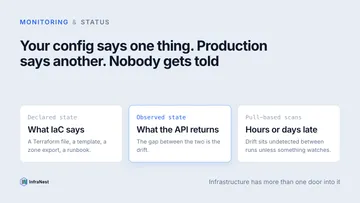
Infrastructure drift explained: what it is and how it creeps in
Infrastructure drift is the gap between what your config says and what's actually running. Here's how it happens, how tools detect it, and how to stay ahead of it.
Serveurs & Cloud7 sept. 2026 · 6 min de lecture
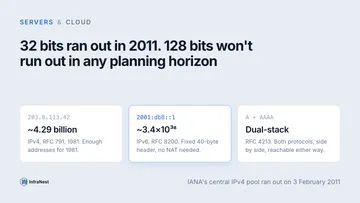
IPv4 vs IPv6 explained: differences, dual-stack, and why it matters
A practical comparison of IPv4 and IPv6 addressing, headers, and NAT — plus what dual-stack means for the servers you run today.
E-mail & délivrabilité26 août 2026 · 5 min de lecture
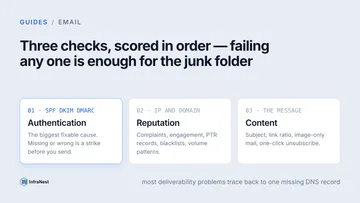
Why your emails go to spam (and how to fix it)
Emails land in spam because of broken authentication, poor sender reputation, or content that trips filters — here's how to diagnose and fix each one.
Domaines & DNS21 août 2026 · 6 min de lecture
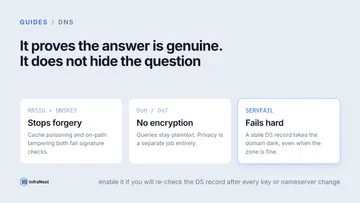
What is DNSSEC and should you enable it?
DNSSEC stops attackers from forging DNS answers, but it's opt-in everywhere and easy to misconfigure. Here's the threat it solves, the trade-offs, and when to turn it on.
E-mail & délivrabilité19 août 2026 · 6 min de lecture
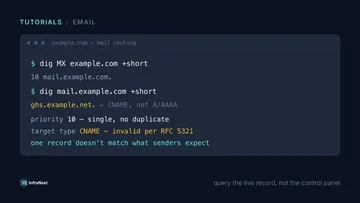
MX record not working: how to diagnose and fix broken mail routing
A step-by-step guide to diagnosing why your MX record isn't routing mail, covering priorities, trailing dots, CNAME targets and stale records.
Serveurs & Cloud17 août 2026 · 5 min de lecture
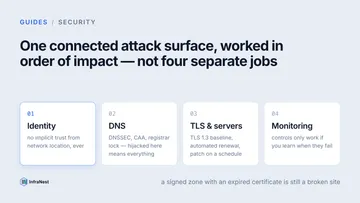
How to secure your infrastructure in 2026: a practical checklist
A practitioner's checklist for securing DNS, TLS, servers and monitoring in 2026 — covering zero trust, DNSSEC, certificate automation and supply chain hygiene.
Domaines & DNS14 août 2026 · 4 min de lecture
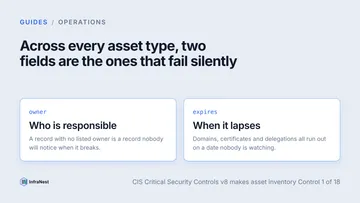
Why infrastructure inventory is important (and what to track)
An unmanaged domain, a forgotten server, or an expired certificate can take down production. Here's why infrastructure inventory is the foundation of reliable, secure operations.
E-mail & délivrabilité5 août 2026 · 5 min de lecture
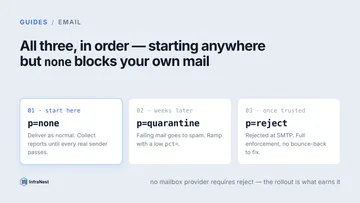
DMARC policy: none, quarantine or reject — which should you use?
A practical guide to choosing p=none, quarantine or reject in your DMARC record, and how to move to full enforcement without breaking legitimate mail.
Surveillance & statut3 août 2026 · 6 min de lecture
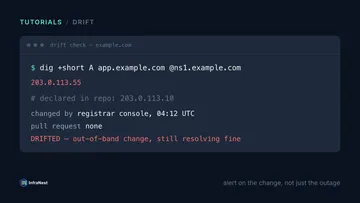
Infrastructure drift detection: get alerted the moment your DNS or config changes
Learn how drift detection catches out-of-band DNS and config changes before they cause an outage, and how to get alerted the moment it happens.
Domaines & DNS31 juil. 2026 · 6 min de lecture
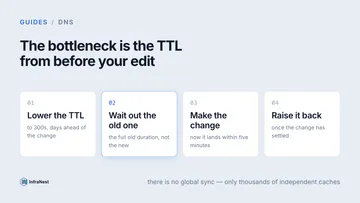
DNS propagation explained: why changes take time and how to check
DNS propagation isn't a global sync — it's TTL-based caching. Here's what actually controls the delay and how to check a change safely.
Domaines & DNS29 juil. 2026 · 5 min de lecture
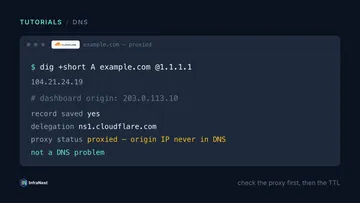
Cloudflare DNS not updating: causes and how to fix it
Changed a DNS record in Cloudflare and nothing seems different? Here's how to tell a caching delay apart from a real config problem, and how to fix each.
Domaines & DNS27 juil. 2026 · 7 min de lecture
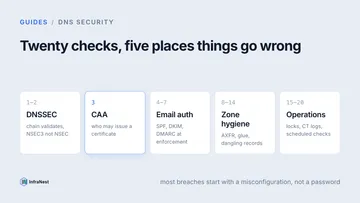
20 DNS security checks every domain should pass
A practical DNS security checklist covering DNSSEC, CAA, SPF/DKIM/DMARC, zone transfers and nameserver hygiene — with commands you can run today.
E-mail & délivrabilité15 juil. 2026 · 5 min de lecture
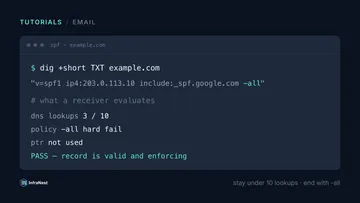
How to create a secure SPF record
Learn how to write an SPF record that actually stops spoofing, without tripping the 10-lookup limit that breaks most real-world setups.
Automatisation13 juil. 2026 · 5 min de lecture
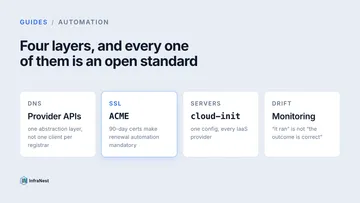
How to automate DNS, SSL and server tasks across every provider
A practical guide to automating DNS changes, certificate renewals and server actions across multiple providers, plus where centralised management beats juggling five dashboards.
Domaines & DNS8 juil. 2026 · 4 min de lecture
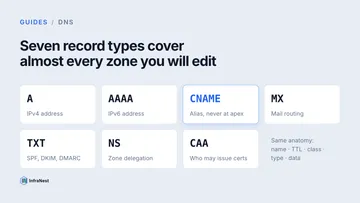
Complete DNS record guide: A, AAAA, CNAME, MX, TXT, NS & CAA
A practitioner's reference to the core DNS record types — A, AAAA, CNAME, MX, TXT, NS and CAA — with a real example and the standards behind each.
Domaines & DNS2 juil. 2026 · 5 min de lecture
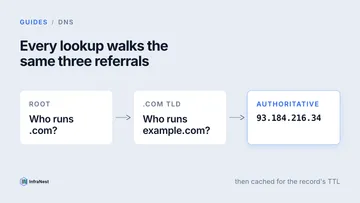
How DNS resolution works: the root-to-authoritative walk explained
A practical walkthrough of DNS resolution: recursive vs authoritative resolvers, the root→TLD→authoritative query path, and how caching affects speed.
Prêt en quelques secondes
Réunissez toute votre infrastructure dans un tableau de bord moderne.
Offre gratuite · Sans carte bancaire · Configuré en quelques minutes