

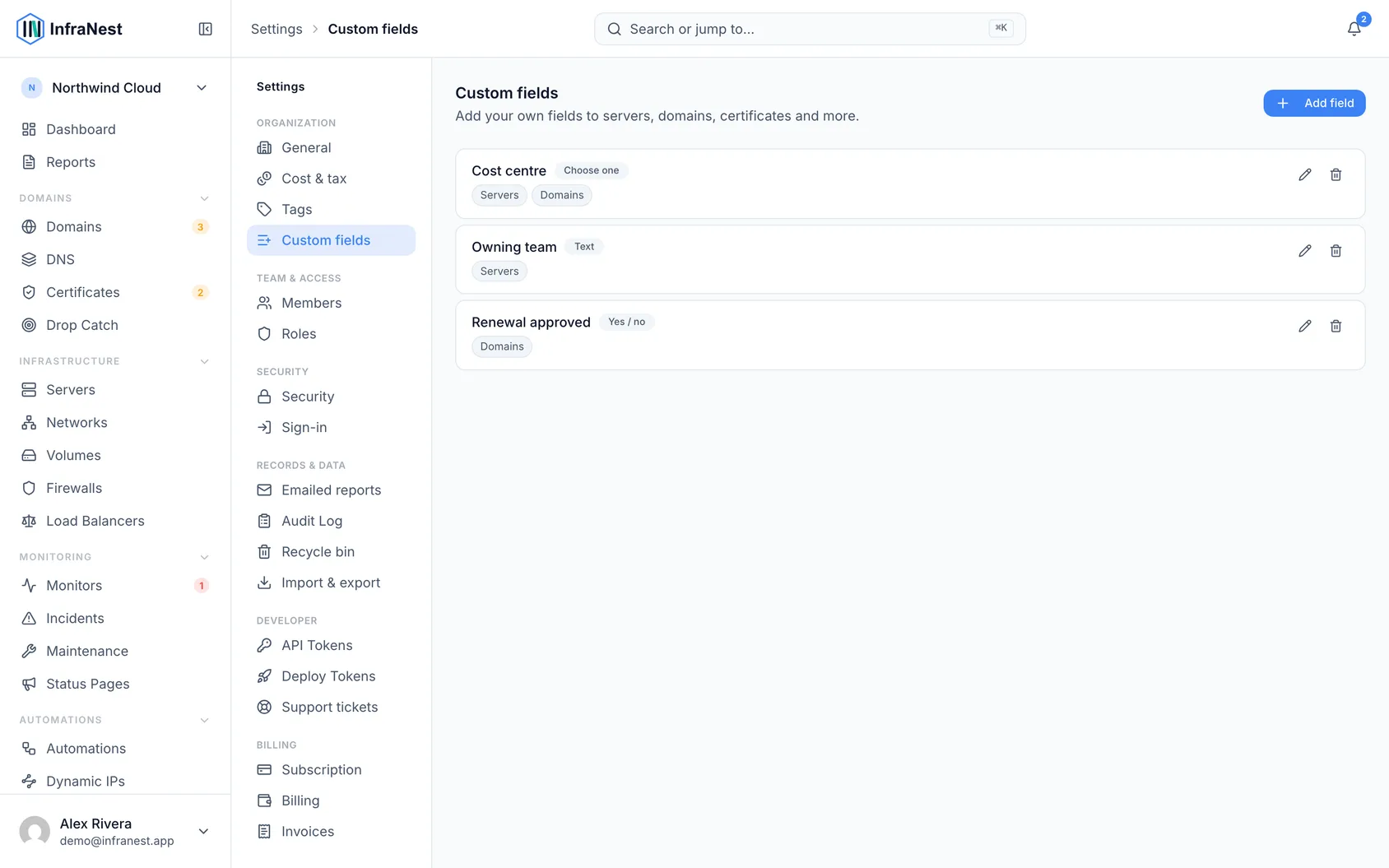
Custom fields let you add your own information to servers, domains, certificates and other records — a client name, a cost centre, a contract end date — so InfraNest tracks exactly what matters to you. Useful for anyone who needs to organize infrastructure by their own criteria, not just what's built in.
Overview
- A custom field is something you define yourself and fill in on each record.
- Common examples: Client or Cost centre to track ownership, Contract end for a date that isn't the renewal date, or Environment to mark production, staging or test.
- A field shared across modules can group records together in reports — for example, a Client field on both servers and domains lets you total spend per client.
Create a field
- Go to Settings → Custom fields.
- Select Add field.
- Give it a Label — for example Client, Cost centre, Contract end.
- Choose a Type: text, number, yes/no, date, link, choice, multiple choice or currency.
- For a choice field, list the Options — one per line.
- Under Applies to, pick the modules the field should show on.
- Choose whether to show it as a column in list views.
- Save.
Fill one in
- Open any record the field applies to — a server, domain, DNS zone or certificate.
- Find the Custom fields panel on that record.
- Enter or update the value — it saves as you go.
If you ticked show as a column, the field also appears as an optional column on that module's list page, where you can sort and filter by it.
Change or remove a field
- Go to Settings → Custom fields.
- Select Edit on the field you want to change.
- Update its Label, Type, Options or Applies to settings as needed.
- Save.
WarningDeleting a field removes its values from every record too, and that can't be undone. If you only want it out of the way, un-tick the modules it applies to instead.
Tips
- Keep field names short and consistent — a shared Client field across servers and domains makes reporting easier.
- Use choice fields instead of free text when you want consistent values for filtering later.
Good to know
- Custom fields are per organization — each organization defines its own.
- Values are included when you export data, so they travel with the rest of your inventory.
- Custom fields are part of a paid plan; if the option isn't there, check your plan.
Cet article vous a-t-il été utile ?