

Free tool
Is it down?
Is a site down for everyone or just you? Run a quick, one-off check from outside your network.
Go beyond this tool. Manage Monitoring across every provider — in one dashboard.
Get started free →When a site won’t load, it’s hard to tell whether the site is actually down or the problem is your connection. This check requests the URL from our servers, follows each redirect one hop at a time, and says which kind of answer came back — a working page, a server that is up with nothing at that address, one that refused us specifically, or an application that failed.
It’s a single, one-off check — for continuous monitoring you want something that watches the site around the clock and alerts you the moment it goes down.
Continuous uptime monitoring
InfraNest checks your sites and services continuously from multiple probes and alerts you the moment something goes down — no manual checking.
- Multi-probe checks with consensus & flapping protection
- Instant alerts across multiple channels
- Uptime stats and response-time charts
- Public status pages for your users
Frequently asked questions
#Is the site down for everyone, or just me?
This check runs from our servers, not your browser or your network. If it reports the site as up while you cannot reach it, the fault is almost certainly between you and the site — your DNS cache, your ISP, a VPN or a local firewall.
#What does the check actually do?
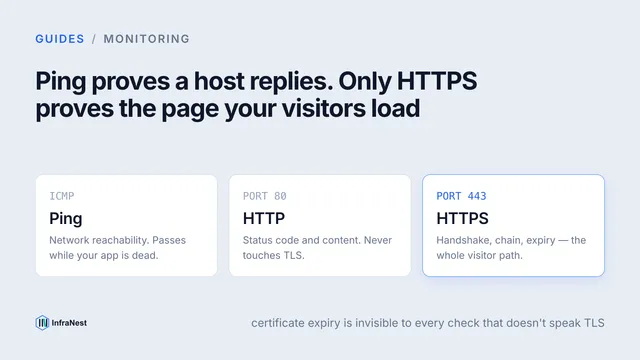
It requests the URL from the edge, follows each redirect in turn so the trail can be shown, and reports the status, the final address and how long the response took. It also asks the plain http:// question separately: a site that answers there and never forwards to HTTPS leaves most visitors on an unencrypted connection, and a single HTTPS request would never reveal it.
#Why does it say up when the page looks broken?
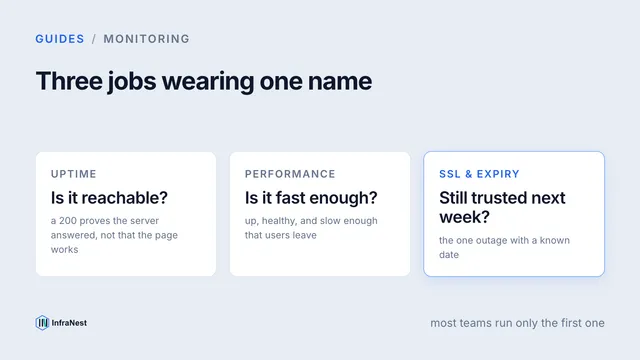
Because a server can answer perfectly while the page itself is wrong — an empty template, a failed database call rendered as a 200, or a JavaScript error. Checking that the response contains an expected word is what distinguishes the two, and it is what keyword monitoring does.
#What do the status codes mean?
2xx is a normal response, 3xx is a redirect (which we follow), 401 and 403 mean the server refused us specifically, 429 means it is rate limiting, and 5xx means the server itself failed. Some sites block automated requests and answer 403 to this check while working fine in a browser.
#How do I find out before my users do?
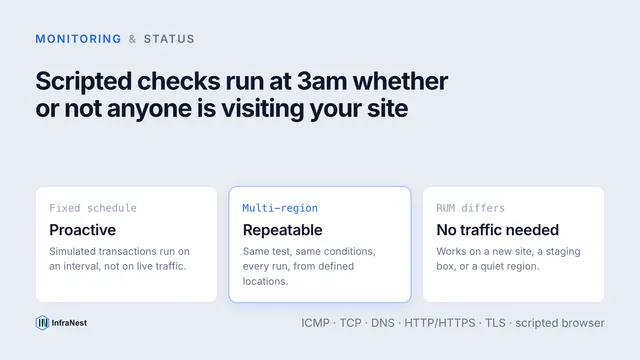
A one-off check only tells you about this moment. Continuous monitoring watches the same URL around the clock from several locations and alerts you the moment the answer changes.
From the blog
More free tools
One lookup is a snapshot
InfraNest keeps checking — across every domain you own — and tells you when the answer changes instead of when a customer does.
Free plan · No credit card required · Set up in minutes