

Free tool
Uptime Calculator
Find out what an SLA really means — '99.9%' is nearly 9 hours of downtime a year.
Try 99.9, 99.95 or 99.999.
| Period | Allowed downtime |
|---|---|
| Per day | 1m 26s |
| Per week | 10m 4s |
| Per month (30d) | 43m 11s |
| Per year (365d) | 8h 45m 35s |
Go beyond this tool. Manage Monitoring across every provider — in one dashboard.
Get started free →Three nines (99.9%) sounds great until you realise it allows almost 9 hours of downtime a year. This calculator translates any SLA into real, allowed downtime so you can set honest targets.
Use it to plan maintenance windows or to evaluate a provider’s SLA.
Know before your users do
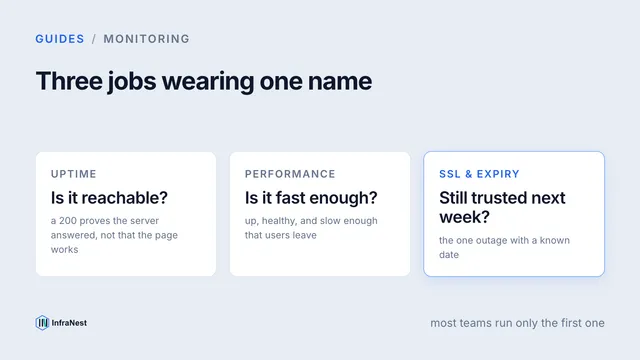
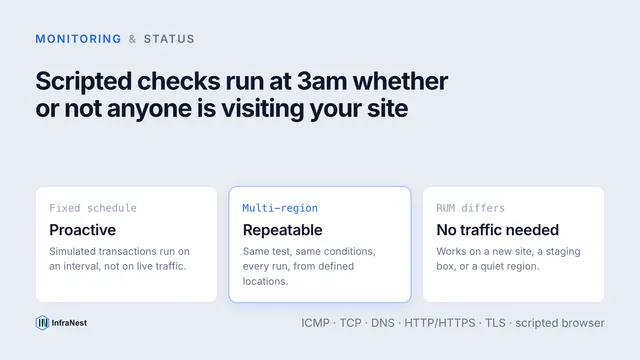
InfraNest monitors your sites and services continuously, with multi-probe checks and smart alerting so you catch real outages fast.
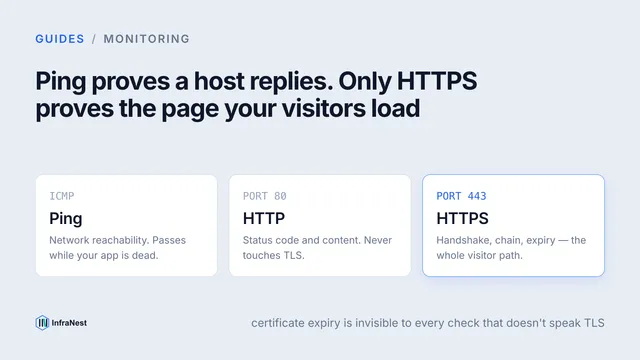
- HTTP, keyword, SSL, DNS, ping & heartbeat checks
- Multi-probe with flapping protection
- Uptime stats & response-time charts
- Public status pages
Other uptime levels
Frequently asked questions
#How much downtime does 99.9% uptime allow?
Just under 8 hours 46 minutes a year — about 43 minutes a month, or 10 minutes a week. "Three nines" sounds close to perfect and is a full working day of outage.
#What is the real difference between 99.9% and 99.99%?
A factor of ten. 99.99% allows roughly 52 minutes a year where 99.9% allows nearly nine hours. Each extra nine costs disproportionately more to deliver, which is why few providers promise more than four.
#Does planned maintenance count against an SLA?
Usually not. Most SLAs exclude maintenance announced in advance, and many exclude third-party network faults too. Read the exclusions before comparing two percentages — they often matter more than the number.
#What uptime should I promise my own customers?
Promise less than you can deliver, and define how it is measured. 99.9% is a defensible commitment for most hosted services; committing to 99.99% means every dependency in the chain has to clear it too.
#How is uptime actually measured?
By probing at a fixed interval from one or more locations, so the check frequency sets the resolution: a five-minute interval cannot see a two-minute outage. Multiple probes agreeing before an incident opens is what keeps a flapping network from inventing downtime.
From the blog
More free tools
One lookup is a snapshot
InfraNest keeps checking — across every domain you own — and tells you when the answer changes instead of when a customer does.
Free plan · No credit card required · Set up in minutes