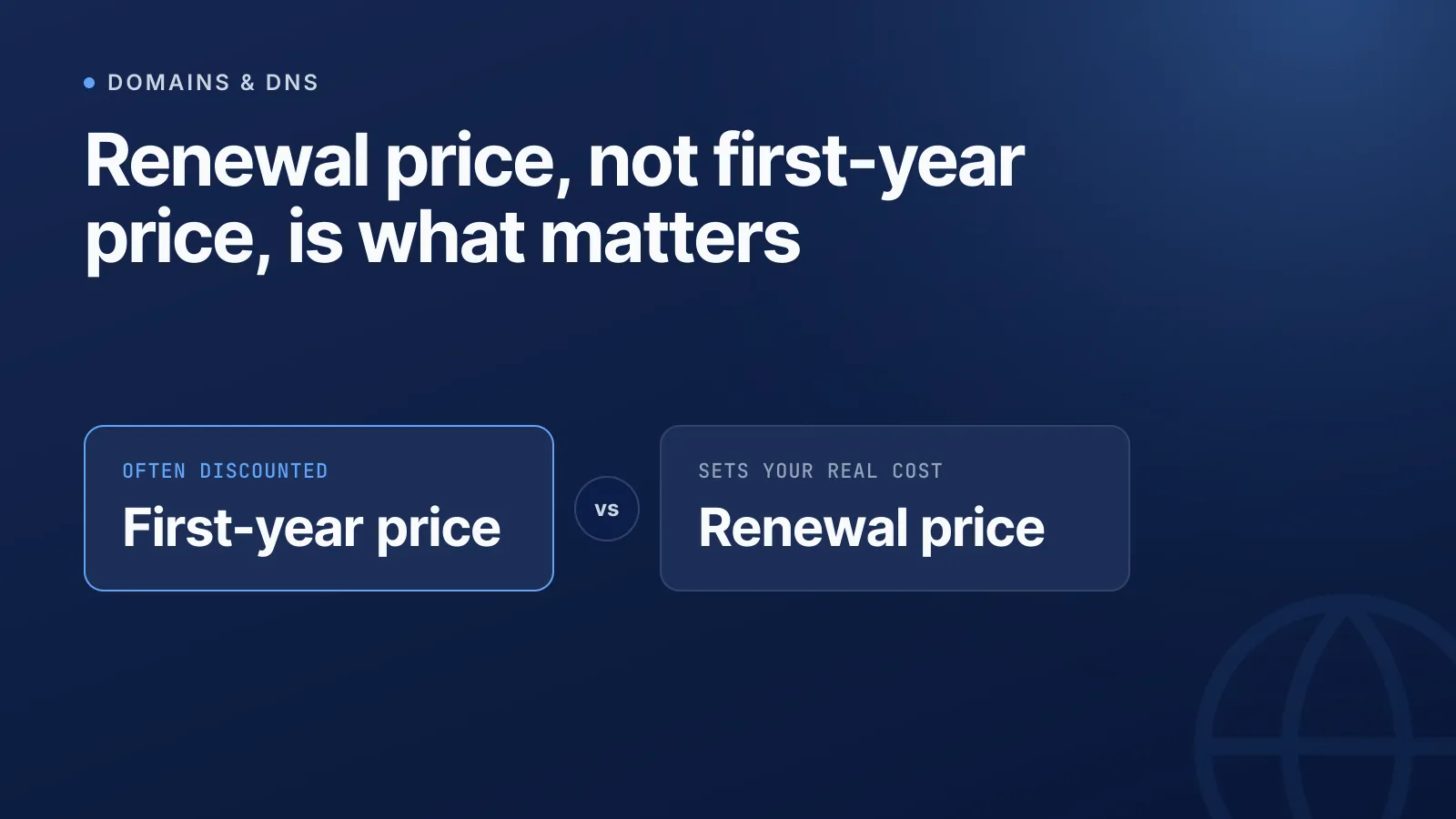
The number that matters when picking a registrar is the renewal price, not the first-year offer that gets you in the door. A domain's real cost shows up on year two, when the discount expires and you either pay a higher rate, pay to transfer away, or do nothing and let the clock run toward expiry fees instead.
Most people compare registrars once, at the moment they register a name, and never look again. That's backwards: the first-year price is the one number every registrar can discount freely, because it's a one-time cost of acquiring you as a customer. The renewal price is the one they actually need to be competitive on, and it's the one most shoppers never check.
Why the renewal price isn't the first-year price
ICANN charges registrars a fixed per-domain-year transaction fee on most generic top-level domains (gTLDs), and registrars commonly pass that through as a separate line item. Beyond that fee, however, ICANN sets no rule requiring first-year and renewal prices to match. A registrar can sell a .com at a loss-leading rate for twelve months and triple it at renewal, and nothing in the ICANN Registrar Accreditation Agreement stops them.
This is why "cheapest domain registration" searches are misleading on their own. The registrar at the top of that list is often the most expensive one to stay with. A handful of registrars (Cloudflare Registrar is a well-known example) publish wholesale, at-cost pricing with no retail markup at all — a useful benchmark when you're judging whether another registrar's renewal quote is reasonable.
Two other costs quietly change the comparison:
- WHOIS privacy. Some registrars bundle it free, others charge an annual add-on — ICANN doesn't mandate either way, so it has to be compared per registrar, not assumed.
- The ICANN fee itself. It's small, but it's not always included in the headline price you see during checkout, which makes two "identical" quotes differ by a few cents per year for no visible reason.
NoteAlways compare renewal price against renewal price. A first-year quote tells you almost nothing about what you'll be paying from year two onward.
What a transfer to a cheaper registrar really costs
If you spot a better renewal rate elsewhere, moving the domain isn't always possible immediately, and it isn't always free. Three things determine the real cost of a transfer:
- The 60-day lock. ICANN's Inter-Registrar Transfer Policy blocks transfers for 60 days after initial registration, after a previous transfer, and after most registrant or contact changes. If you just registered or moved a domain, or just updated the owner's details, you'll likely have to wait it out.
- The transfer fee itself. Most registrars charge a transfer-in fee, and that fee usually bundles an extra year onto the domain's expiry date — so you're not just paying to move, you're prepaying a year you may not have needed yet.
- Losing time against a close expiry date. Registrars generally won't transfer a domain that's too close to expiring, since the receiving registry needs enough runway to process the move.
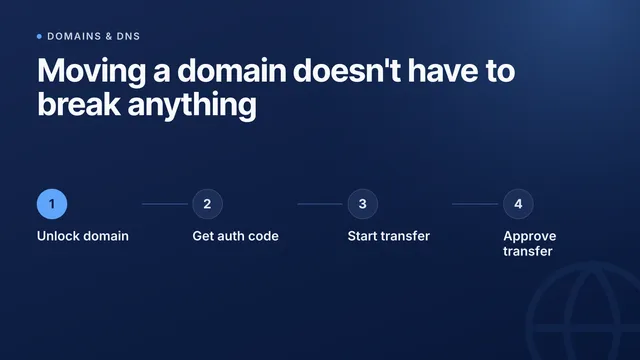
Our step-by-step guide to transferring a domain walks through the mechanics in detail if you've already decided to move. The point for a price comparison is simpler: a transfer only makes sense if the saving over a few years clearly beats the transfer fee and the hassle of the 60-day wait.
Grace periods, redemption fees, and why timing matters
Domain registries run on a handful of standard grace periods, defined in RFC 3915. They matter for price comparisons because missing one turns a routine renewal into an expensive recovery:
- Add grace period (around 5 days): if you register a name by mistake, most registries allow a refund if it's deleted almost immediately.
- Renew and auto-renew grace periods: a short window after a renewal charge where it can still be reversed if something goes wrong.
- Transfer grace period: a short window after a transfer completes.
- Redemption grace period (typically ~30 days after deletion): the domain can be restored, but usually only for a steep redemption fee — often many times the normal renewal price.
ICANN's Expired Registration Recovery Policy requires registrars to send at least two renewal reminders before a domain lapses, precisely because redemption fees are so much worse than just renewing on time. If you're shopping registrars on price, factor in how clearly each one surfaces upcoming renewals — a cheaper renewal rate is worthless if you miss it and pay a redemption fee instead.
WarningA domain that slips into the redemption grace period usually can't just be renewed at the normal price. Recovering it typically costs significantly more than letting it auto-renew would have.
How to compare registrar prices before you buy or renew
In practice, comparing registrars means checking the same name against several providers at the same moment, in the same currency, including whatever add-ons (privacy, the ICANN fee) each one bundles differently. Doing that by hand means opening several tabs, running the same search on each, and normalising the currency yourself.
An illustrative comparison for one name across generic registrars looks like this:
| Registrar | First-year price | Renewal price | WHOIS privacy |
|---|---|---|---|
| Registrar A | €4.99 | €18.99 | Included |
| Registrar B | €9.99 | €12.49 | €4.99/yr |
| Registrar C | €0.99 | €21.99 | Included |
Registrar A and C look cheapest at checkout, but Registrar B is the cheapest once you look at what you'll actually pay in year two and beyond — the exact pattern that makes first-year prices a poor way to choose.
InfraNest's domain management runs this comparison for you against the registrars you've already connected: type a name once, and InfraNest asks each connected registrar for its price and shows them side by side in one currency, cheapest marked. You buy directly in your own account at the registrar's own price — InfraNest never adds a markup or takes the payment. The same screen can also check several TLD endings for one name, or several names at once, so you're not re-running the same search manually for every variant. The docs on registering a domain cover the exact steps, including setting up DNS automatically for whatever you register.
For domains you already hold, InfraNest compares renewal price against renewal price across the registrars you've connected — never against a first-year offer — and only proposes a move when the saving clears a meaningful threshold and beats the transfer cost over a few years. It handles the transfer, checks for the common blockers (lock, the 60-day rule, a close expiry date) up front, and restores transfer lock, privacy and auto-renew once the domain lands. You can also turn on auto-renew per domain so a good renewal rate never turns into a missed deadline — covered in the renewal docs.
FAQs
Check a domain's current registrar and renewal date any time with a WHOIS lookup if you're not sure who it's registered with before you start comparing.
Ready to see where your own domains stand? Explore domain management and compare renewal prices across the registrars you already use.
Frequently asked questions
#Is the cheapest first-year price ever a good signal?
Not on its own. A low first-year price tells you nothing about the renewal rate, which is what you'll actually pay from year two onward — always check both numbers before registering.
#Can I transfer a domain right after I buy it?
Usually not. ICANN's transfer policy locks a domain against transfers for 60 days after initial registration, after a previous transfer, and after most contact changes.
#Does WHOIS privacy always cost extra?
It depends on the registrar. Some bundle it into the base price, others charge an annual add-on fee — ICANN doesn't require either approach, so it needs checking per registrar.
#What happens if I miss a renewal and the domain expires?
Most registries hold the domain in a redemption grace period of around 30 days, but restoring it there typically costs a steep redemption fee, far more than a normal renewal would have.
Try it with a free tool
Was this article helpful?