

This article is for InfraNest users who want their infrastructure automations to react to activity in their GitHub repositories, and to take action on GitHub automatically — no coding required.
Overview
- Build automations that watch for things happening on GitHub, like a failed workflow run or a new pull request, and respond automatically.
- Trigger GitHub actions — like creating an issue or merging a pull request — from any automation in InfraNest.
- Everything is set up visually in the automation builder, using GitHub triggers and actions.
NoteBefore you can use GitHub triggers or actions, you need to connect your GitHub account. If you pick a GitHub trigger first, InfraNest will remind you to connect.
Connect GitHub
- Go to Integrations.
- Find GitHub and select Connect GitHub.
- Choose Connect with {provider} or Install GitHub App, and follow the prompts to authorize access.
- Once connected, GitHub triggers and actions will appear grouped under GitHub in the automation builder.
React to GitHub activity
- Open Automations and select New automation.
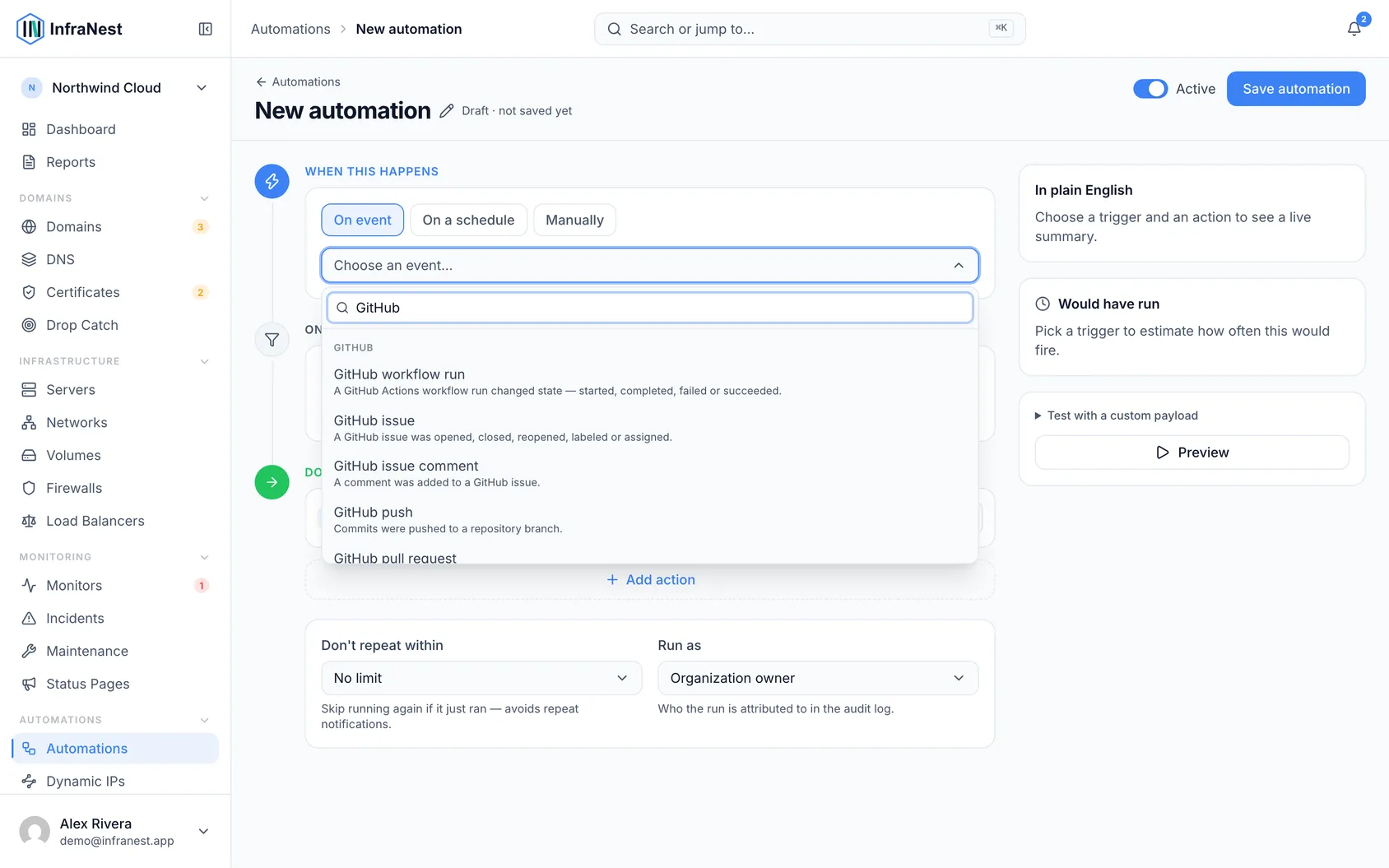
- Under When this happens, choose On event.
- Pick a GitHub trigger, such as:
- GitHub workflow run — started, finished, failed or succeeded
- GitHub issue or GitHub issue comment — opened, closed, labeled, assigned or commented
- GitHub push, GitHub branch/tag created or GitHub branch/tag deleted
- GitHub pull request or GitHub PR review — opened, merged, closed, approved or changes requested
- GitHub release — published
- GitHub deployment, GitHub deployment status, GitHub commit status, GitHub check run or GitHub check suite
- Use Add condition to add Only if filters — for example, only for the
mainbranch, a specific repository, only failures, or only your Organization account rather than a personal one. - Start typing in the Repository (owner/repo) field to pick from your connected repositories.
Act on GitHub
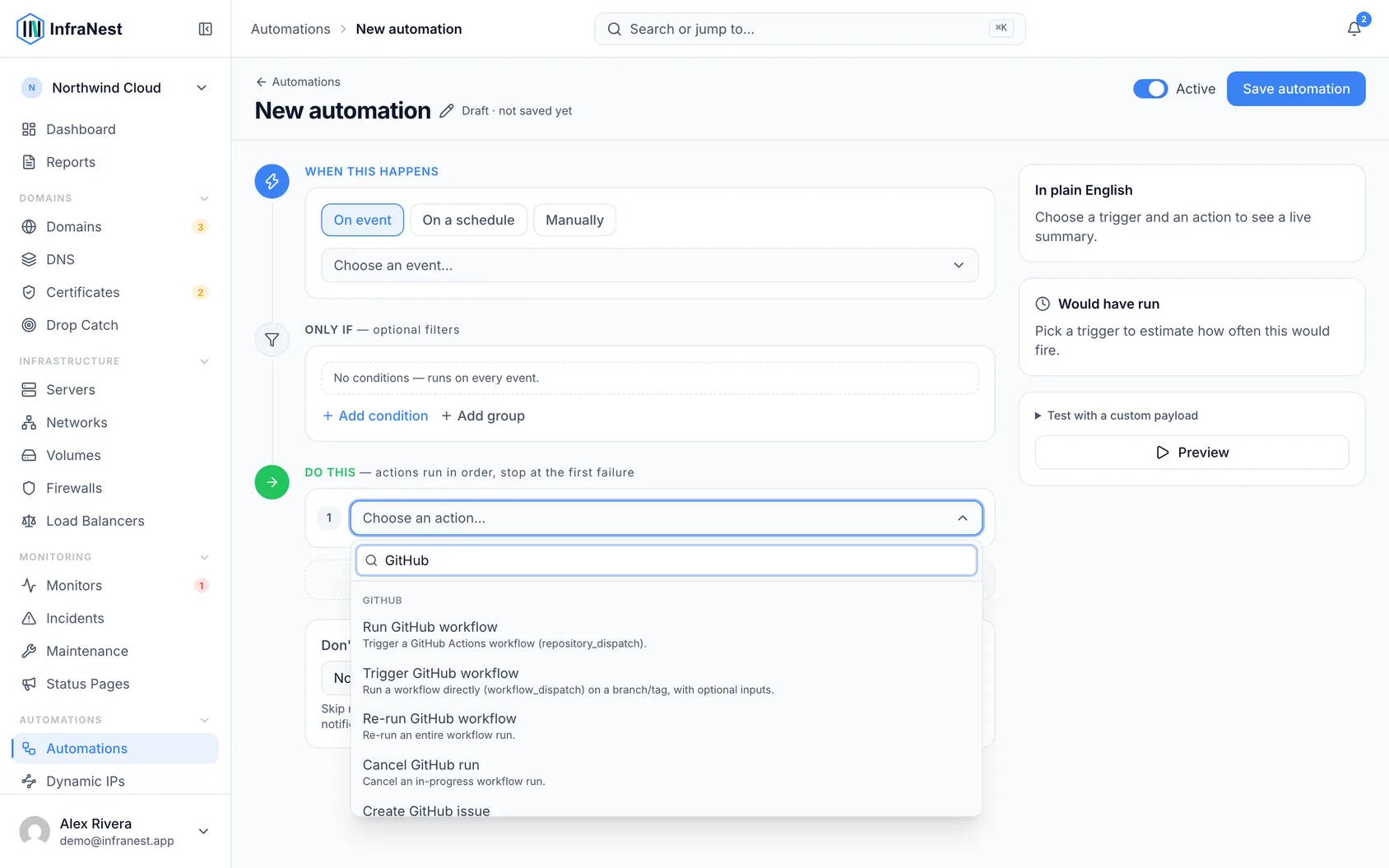
- In your automation, go to Do this and select Add action.
- Choose a GitHub action from the list, such as:
- Trigger GitHub workflow, Re-run GitHub workflow, Re-run failed jobs, or Cancel GitHub run
- Create GitHub issue, Comment on GitHub issue, Update GitHub issue, Close GitHub issue, Reopen GitHub issue, Add issue labels, Remove issue label, or Assign GitHub issue
- Merge pull request, or Request PR review from people or a Teams entry
- Create GitHub deployment, Set deployment status
- Create GitHub release
- Set commit status
- Fill in the fields for that action — for example Repository (owner/repo), Workflow file or id, Branch or tag, Environment, Labels (comma-separated), Assignees (comma-separated), or Reviewers.
- For any field, you can type a value directly, pick a suggestion from your connected GitHub account, or use Insert value to pull in a placeholder from the trigger.
- Select Add action again to add more steps, or Save automation when you're done.
Examples
- SSL renewal failed → Create GitHub issue, add the label
infrastructure, and use Assign GitHub issue to assign it to your DevOps team. - A monitor recovered → Comment on GitHub issue, then Close GitHub issue.
- A pull request merged into
main→ Run GitHub workflow to deploy, then Set deployment status. - Your production health check passed → Set commit status to success.
- A release was published → Post status-page announcement.
Tips
- When one action creates something — like an issue or a deployment — later steps in the same automation can reuse it automatically, without extra setup.
- Requesting a review from a Teams entry requires an Organization connection, not a personal account.
TipSome actions show a Pro badge in the builder — these require a higher plan to use.
Troubleshooting
- If a GitHub trigger never fires, check that GitHub is properly connected under Integrations, and ask your administrator to confirm the app is subscribed to that type of event.
- If an automation shows Last run failed or gets Auto-disabled after repeated failures, open the automation and check Run history for details, then use Retry or Re-run as needed.
Was this article helpful?