

Connect your GitHub account or organisation to InfraNest so your automations can react to what happens in your repositories, and take action back on GitHub for you. This is for anyone who wants InfraNest to watch GitHub activity or manage GitHub issues, deployments and pull requests automatically.
#Overview
- Once connected, InfraNest can watch pushes, pull requests, issues, workflow runs, deployments, releases and checks, and act on GitHub as part of an automation — for example opening an issue, running a workflow, merging a pull request or updating a deployment's status.
- GitHub can also be used to track incidents and findings, similar to Jira or Linear: connected accounts can open a GitHub issue for every incident and close it automatically when the incident resolves.
- Accounts connected with the app can also show their deploys next to your monitors.
#Connect GitHub
The easiest and most secure way is to install the InfraNest Automations app on your GitHub account or organisation.
- Go to Integrations and open GitHub.
- Select Connect (or Add account if you've already connected one).
- Under Install app, select Connect. A GitHub window opens. Choose the account or organisation to install on, pick All repositories or just the ones you want InfraNest to see, and confirm.
- GitHub may ask you to confirm that InfraNest can check which installations your account can use. This is how InfraNest makes sure the installation really is yours before connecting it.
- You're returned to InfraNest and the connection appears under Accounts.
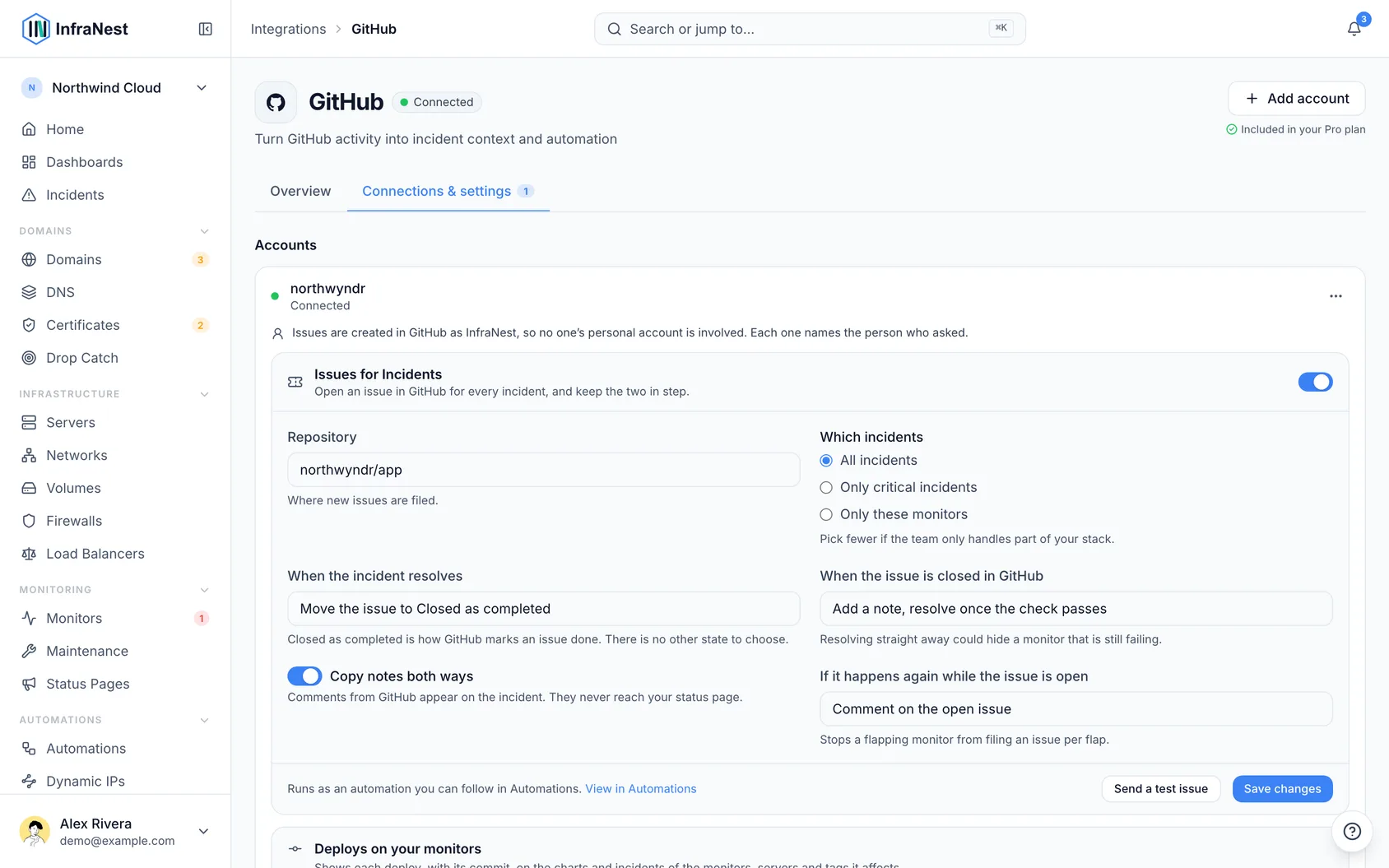
You can connect more than one account — for example your personal account and an organisation. Each shows up as its own connection.
NoteInfraNest works with GitHub.com only. GitHub Enterprise Server (self-hosted GitHub) isn't supported.
#Not an owner of the GitHub organisation?
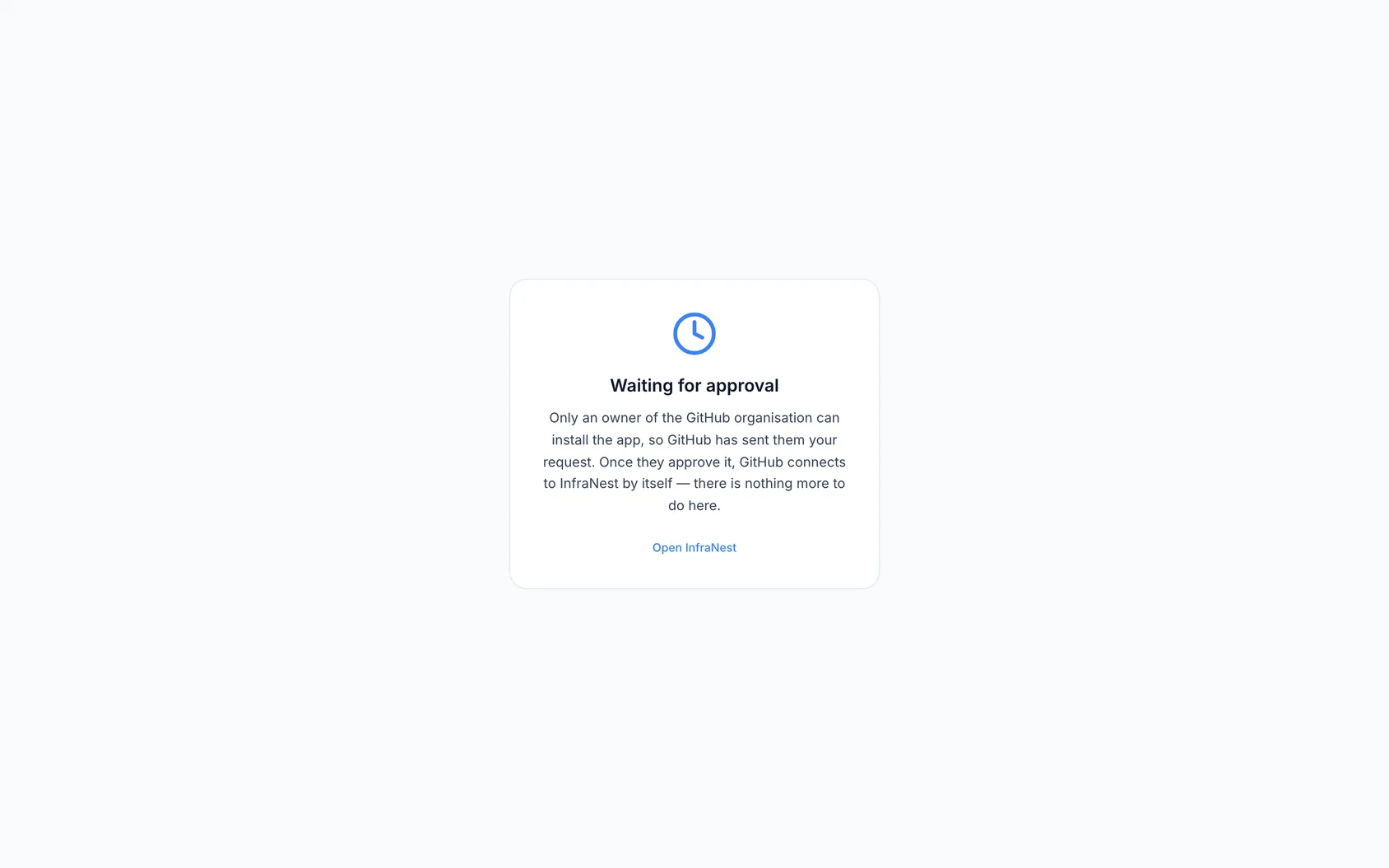
Only an owner of a GitHub organisation can install apps on it. If you're a member, GitHub sends your request to the organisation's owners instead, and InfraNest shows Waiting for approval. You don't need to do anything else: as soon as an owner approves the request on GitHub, the connection appears in the workspace you started from. If it hasn't appeared after the owner approved, connect again from InfraNest.
#Installed it from GitHub?
If you installed InfraNest Automations from GitHub itself (for example from the GitHub Marketplace), InfraNest asks you to sign in, or create an account, and choose the workspace the installation belongs to. The link to finish this is valid for 30 minutes; after that, connect GitHub from InfraNest instead.
#Can't install the app?
If you're not allowed to install apps on your GitHub account or organisation, you can connect with a personal access token instead: choose API token rather than Install app. A token lets automations act on GitHub, but it can't start them — GitHub triggers only work with the app.
#Choose what InfraNest can see
While installing the app you decide which repositories InfraNest has access to. To change this later, open the app on GitHub (under your account or organisation Settings → GitHub Apps → InfraNest Automations) and adjust the selected repositories.
#Disconnect GitHub
- Open GitHub in the Integrations hub.
- Go to Connections & settings.
- Select Disconnect.
This also uninstalls the app on GitHub, so InfraNest no longer has access. If the same installation is shared with another workspace, it's left in place there. A connection made with Connect with GitHub has its access withdrawn on GitHub in the same way.
Disconnect first shows, in a dialog, what stops, what InfraNest removes and what it keeps. Any automation that used the connection is switched off, so none of them fails quietly later. The rest of your team gets a notification naming who disconnected it and which automations were switched off; you chose it, so you don't get one. If GitHub ends the connection on its side, everyone is notified. Issues for Incidents goes with the connection, and connecting the same installation again within 30 days offers to turn it back on as it was.
If someone uninstalls or suspends the app on GitHub itself, InfraNest notices: the connection shows as failing, with Removed on the provider's side or Suspended on the provider's side under its name, it's listed under Needs attention, you get a notification, and automations that use it stop with a message saying why. To bring it back, connect GitHub again with the same account (or unsuspend the app on GitHub). Your automations keep their settings and start working again straight away. If repositories are taken away from the app on GitHub, the connection lists which ones it can no longer reach.
If GitHub asks InfraNest to slow down because of its rate limit, the connection is listed under Needs attention as waiting until a given time. There's nothing to fix: it clears by itself, steps set to retry try again on their own, and the notice disappears once the limit resets.
#What InfraNest keeps
InfraNest receives an event from GitHub for every push, issue, comment, pull request and so on in the repositories you chose — whether or not an automation uses it.
- Event history — used to show how often a draft automation would have run. It keeps which repository, which issue or pull request number, who did it and what happened, for 45 days. It does not keep the text people write: issue and pull request titles, comments, release names and descriptions are left out.
- Run history — when an automation actually runs, its run keeps the full event it ran on, comment text included, for 90 days. Only members whose role can edit automations can see it. Everyone else sees that a run happened and whether it worked.
Disconnecting stops new events from arriving. What InfraNest already holds is removed when those 45 and 90 days run out.
#Whose name is used
Installed as the GitHub App, InfraNest creates issues and comments as infranest[bot], not as anyone's personal account. Connected with a personal access token, it creates them as the GitHub account the token belongs to. The connection's row on the GitHub page says which.
Either way, every issue ends with Filed from InfraNest by and the name of who asked — or Filed by InfraNest automatically when an automation filed it — and a team note copied to the issue starts with the name of who wrote it. When the person whose token a connection uses leaves your InfraNest workspace, its owners and admins get a message and an email with a link to connect GitHub again.
#Tips
TipTeam-based features, like requesting a review from a team, only work when you connect an organisation, not a personal account.
#Troubleshooting
- "We couldn't confirm your access" — you were signed in to GitHub with an account that can't use that installation. Sign in to GitHub with the account that installed the app and connect again.
- "Took too long" — start the connection again from InfraNest.
- Your credentials are stored securely and never shown again.
Was this article helpful?
Thanks for your feedback!
Thanks, this goes straight to the docs team.
Related articles
 GitHubSee your deploys next to your monitorsWhen something goes down right after a release, see that straight away, without comparing times in GitHub.CalendarProSubscribe with a calendar feed (iCal)Subscribe to a private link and your renewals, certificate expiries and maintenance windows appear in any calendar app — Apple Calendar, Outlook, Google…CalendarAbout calendar syncPut your renewals, expiries and maintenance windows in the calendar you already use, so a domain never lapses because nobody was looking at InfraNest that week.
 ConfluenceConnect ConfluenceConnect Confluence and the review your team writes after an incident can be published to a Confluence space: a page titled Postmortem: with the incident's…