

Connect n8n to InfraNest so the two tools can set off actions in each other — for anyone who builds workflows in n8n and wants them tied to their infrastructure alerts.
#Overview
- Start an n8n workflow when a domain is expiring, a monitor goes down or a certificate is about to lapse.
- Let an n8n workflow open a maintenance window, pause a monitor or resolve an incident in InfraNest.
- Both directions work with a URL you copy between the two tools, whether your n8n is cloud-hosted or self-hosted.
#Before you start
- In n8n, add a Webhook node to a workflow.
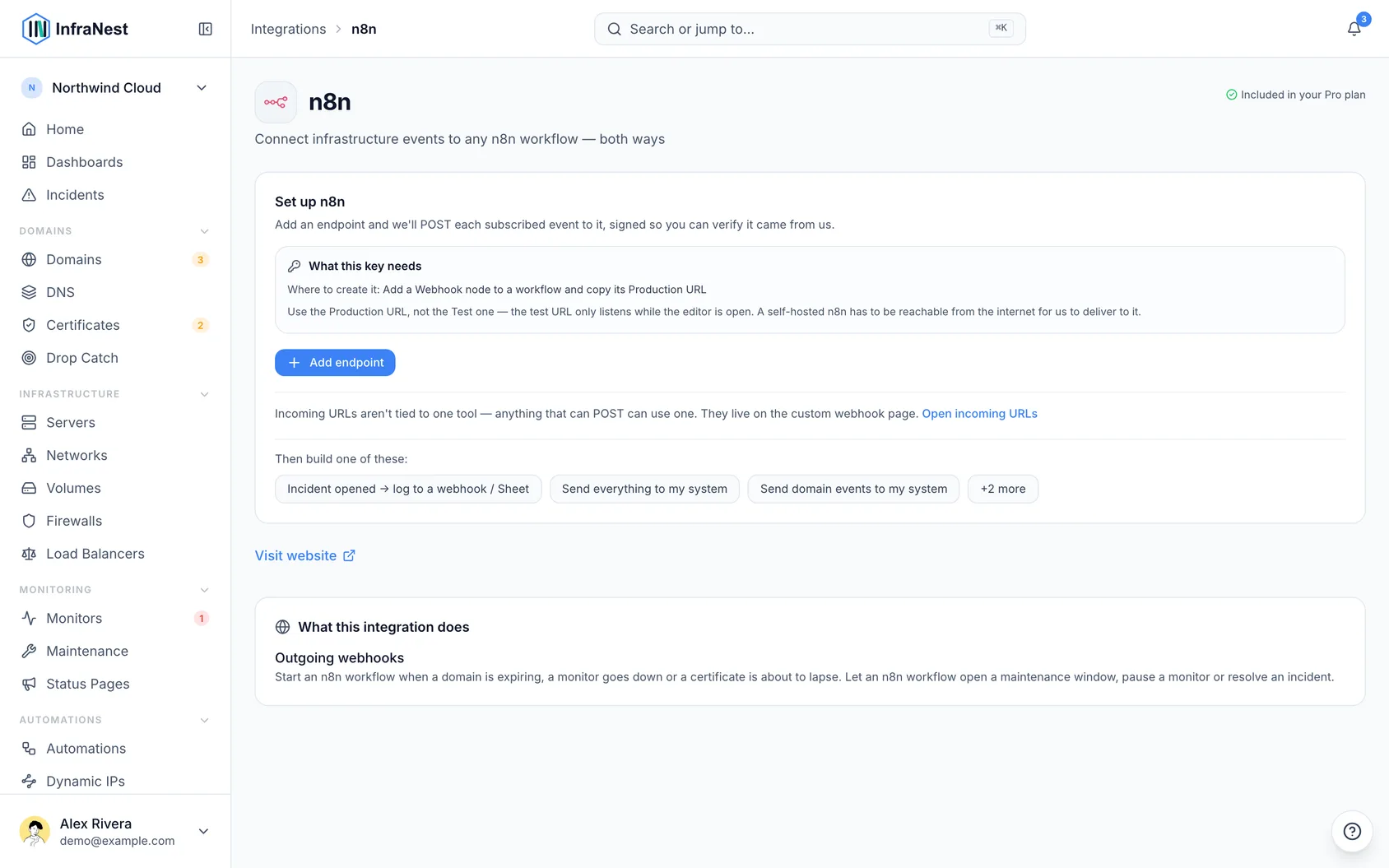
- Copy its Production URL — not the Test URL. The test URL only listens while the editor is open, so deliveries stop the moment you close it.
NoteIf you self-host n8n, that address has to be reachable from the internet for InfraNest to deliver to it.
#Send InfraNest events to n8n
Go to Integrations → n8n and select Add endpoint. Before anything is set up it's on the Set up n8n card; after that it's under Where events go on the Connections & settings tab.
Paste the Production URL into Endpoint URL. Leave Send every event here ticked, so every event is sent from the start, and select Create.
Copy the signing secret shown once after saving, if you want to verify that deliveries really came from InfraNest.
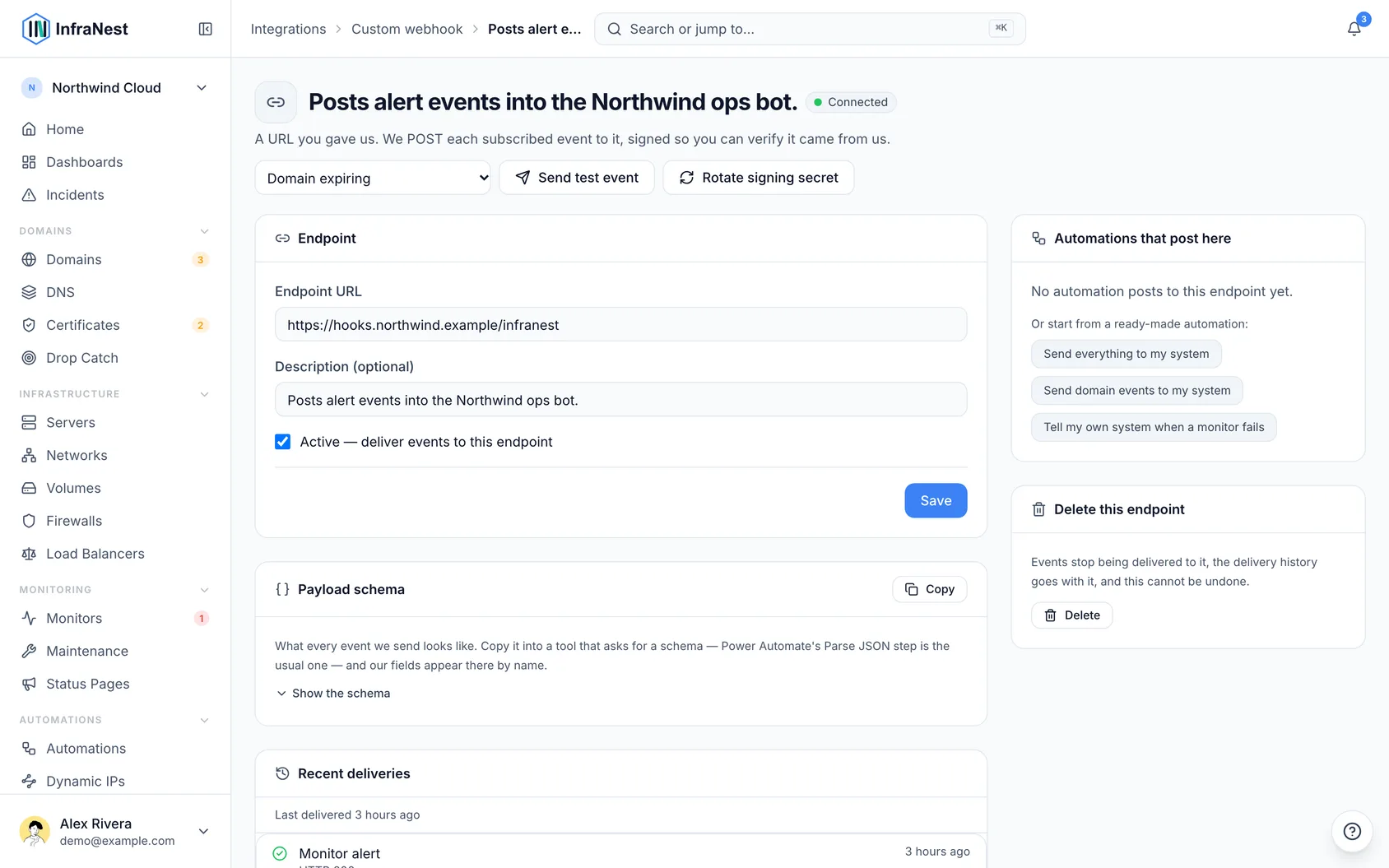
On the endpoint's page, pick an event in the list next to Send test event, then select Send test event. Your workflow can then be built against a real payload.
Choose what gets sent: under Automations that post here, the endpoint's page lists the Send everything to … automation it started. Open it to narrow it to the events you care about — or, if you unticked the box, pick a starting point under Or start from a ready-made automation: or build your own rule.
#Let n8n trigger InfraNest
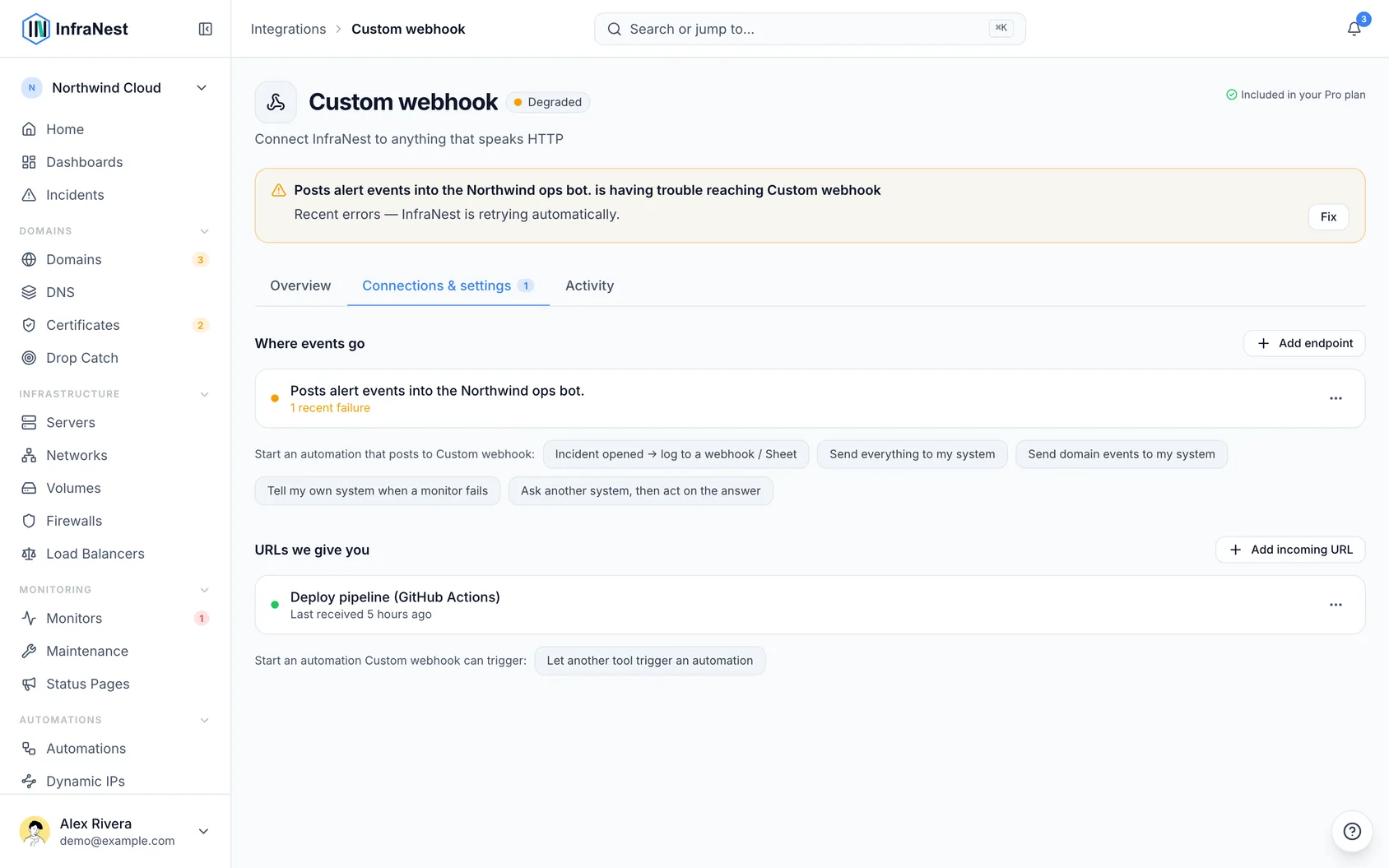
- Go to Integrations → Custom webhook and select Add incoming URL (under URLs we give you on the Connections & settings tab, once anything is set up there). Incoming URLs belong to no single tool, so they live there: on the n8n page, Open incoming URLs takes you to them.
- Give it a Name you'll recognise later — you pick it by name when writing the rule.
- Optionally set a Shared secret (optional), so a leaked URL on its own isn't enough to trigger anything.
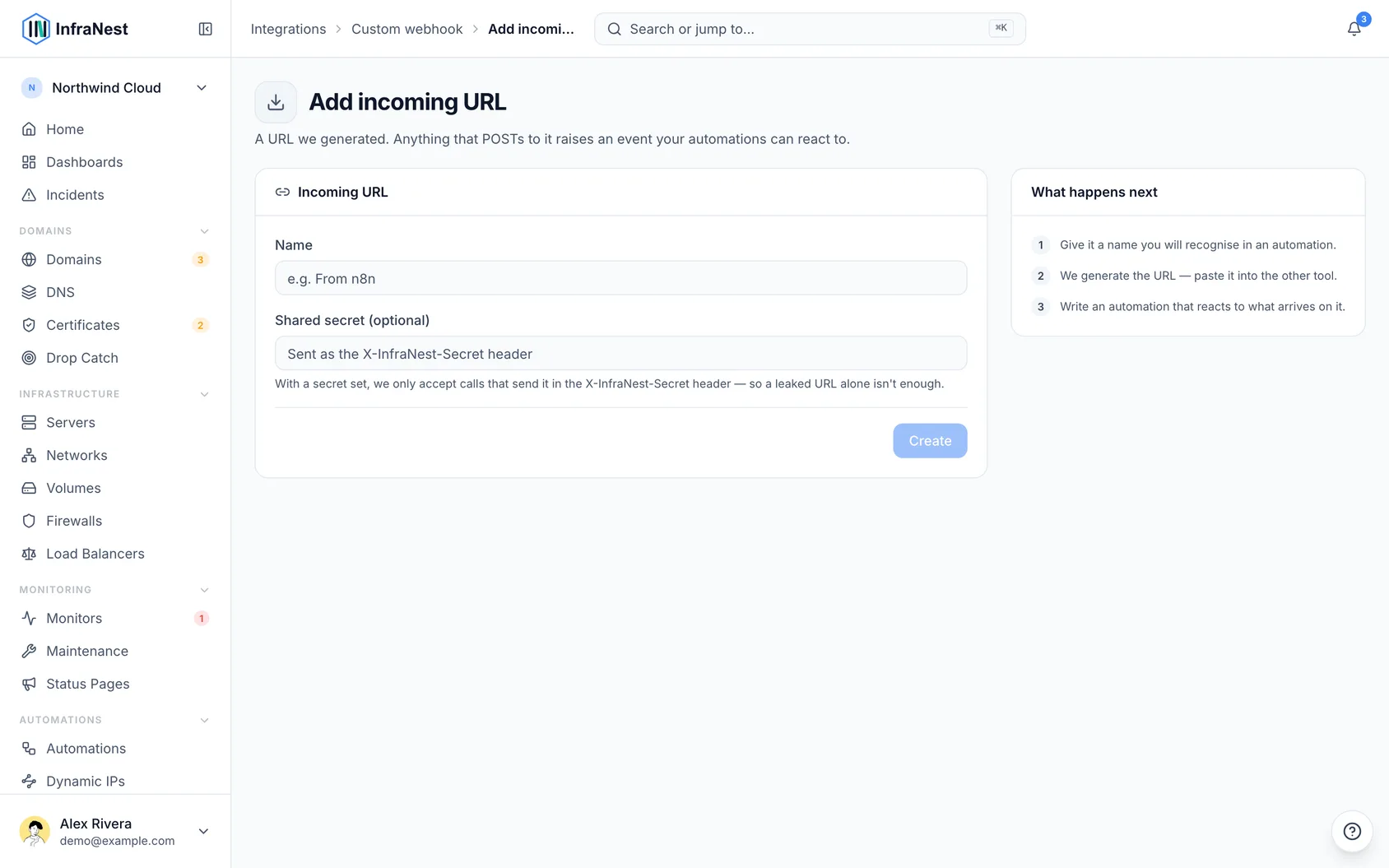
- Copy Your URL into an HTTP Request node in your workflow, set to POST, with the body sent as JSON. If you set a secret, add it as the
X-InfraNest-Secretheader. - Back in InfraNest, start an automation from Let another tool trigger an automation (or with the Incoming webhook trigger) and add what should happen — open a maintenance window, pause a monitor, resolve an incident. What the workflow sent is available in the rule as
{{payload.your_field}}.
#Tips
TipYou can add more than one endpoint — for example one workflow for incidents and another for domains.
#Good to know
- The signing secret is shown once and never again. Rotate signing secret on the endpoint's page gives you a new one; the old one stops working immediately.
- Your incoming URL works like a password. Anyone holding it can trigger your workspace's automations, so set a shared secret and use Regenerate URL if it leaks.
- What went out is listed under Recent deliveries, on the endpoint's page and on the n8n page's Activity tab, with what n8n answered. A failed delivery has a Retry button.
- What came in is listed under What has arrived on the incoming URL's page, including calls InfraNest turned away and why.
- For what a delivery contains and how to check its signature, see Connect a custom webhook.
#Troubleshooting
Deliveries stop when you leave the n8n editor. That's the Test URL. Swap the endpoint to the node's Production URL and activate the workflow.
Nothing arrives, and n8n is self-hosted. InfraNest has to be able to reach it from the internet — check that the address resolves publicly and isn't behind a VPN, a local-only firewall rule or an allowlist. The delivery log on the n8n page shows the error received.
Your workflow doesn't trigger InfraNest. Confirm the HTTP Request node posts to the exact incoming URL, and that the shared secret — if you set one — is sent as the X-InfraNest-Secret header. Then open the incoming URL's page: What has arrived lists every call, and a call that was turned away says why. Send the body as JSON — anything else arrives empty.
Was this article helpful?
Thanks for your feedback!
Thanks, this goes straight to the docs team.
Related articles
 MakeConnect MakeStart a Make scenario when a domain is expiring, a monitor goes down or a certificate is about to lapse — and let a scenario open a maintenance window, pause…
 Power AutomateConnect Power AutomateStart a Power Automate flow when a domain is expiring, a monitor goes down or a certificate is about to lapse — to open a ticket, add a row to a SharePoint…
 ZapierConnect ZapierStart a Zap when a domain is expiring, a monitor goes down or a certificate is about to lapse — and let a Zap open a maintenance window, pause a monitor or…