

Set up a Dynamic IP so your router keeps DNS records and firewall rules pointed at your address, even when your internet provider changes it. This is for anyone on a home or office connection without a fixed IP address.
Overview
- Creates an address you can update automatically from your router
- Gives you the exact values your specific router needs to send updates
- Lets you pick which DNS records and firewall rules should always follow your current address
- Works even if you have several routers or locations, each with its own Dynamic IP
Create it
- Go to Dynamic IPs (under Automations) and select New Dynamic IP.
- Give it a name you'll recognise later — "Home", "Office VPN".
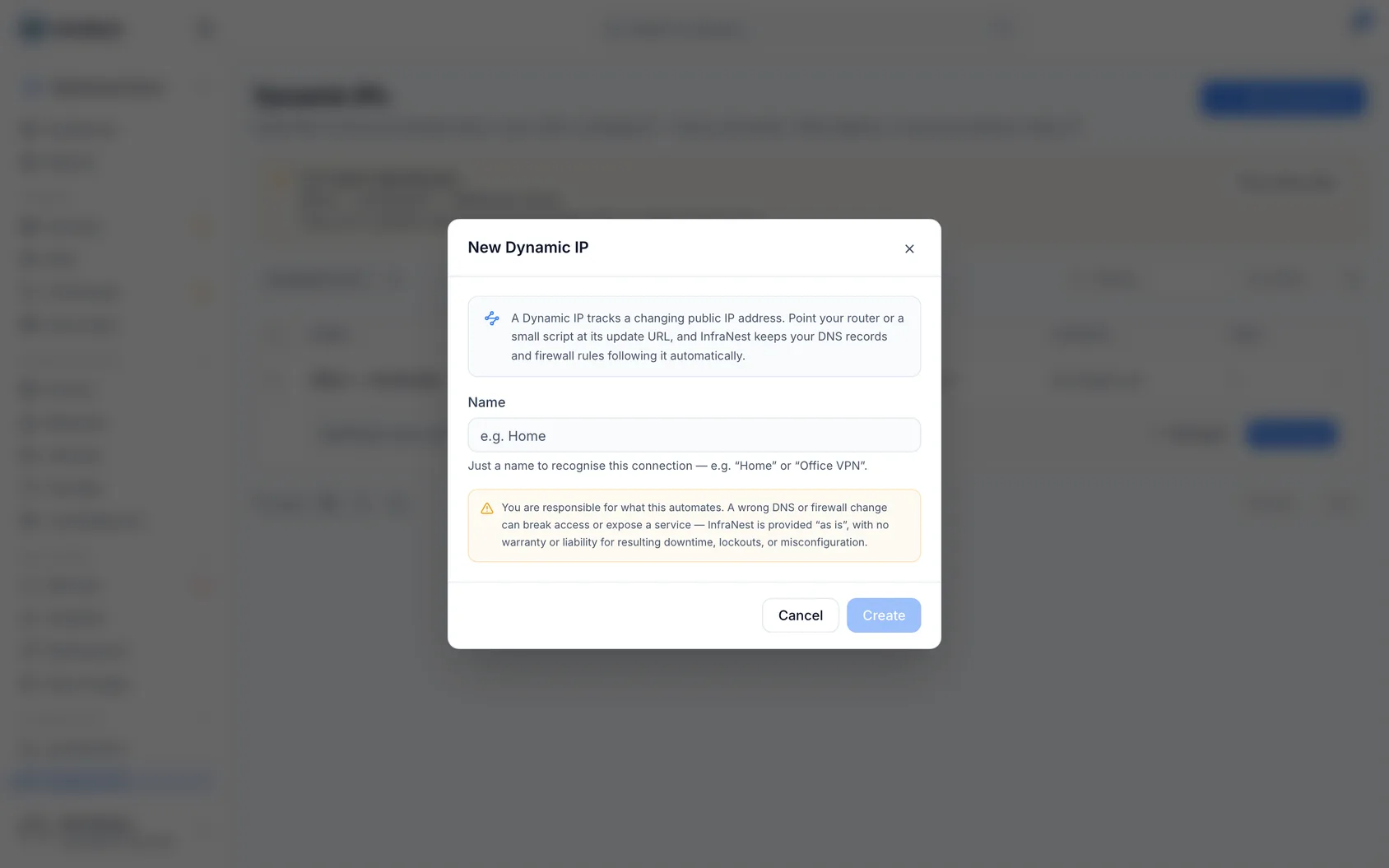
That's it. The next screen has everything your router needs.
Tell your router where to send updates
- Open the Dynamic IP and go to the Setup tab.
- Pick your device from the list at the top — most routers, FRITZ!Box, UniFi, Synology, ddclient, or command line. The page shows the exact value for each box that device asks for.
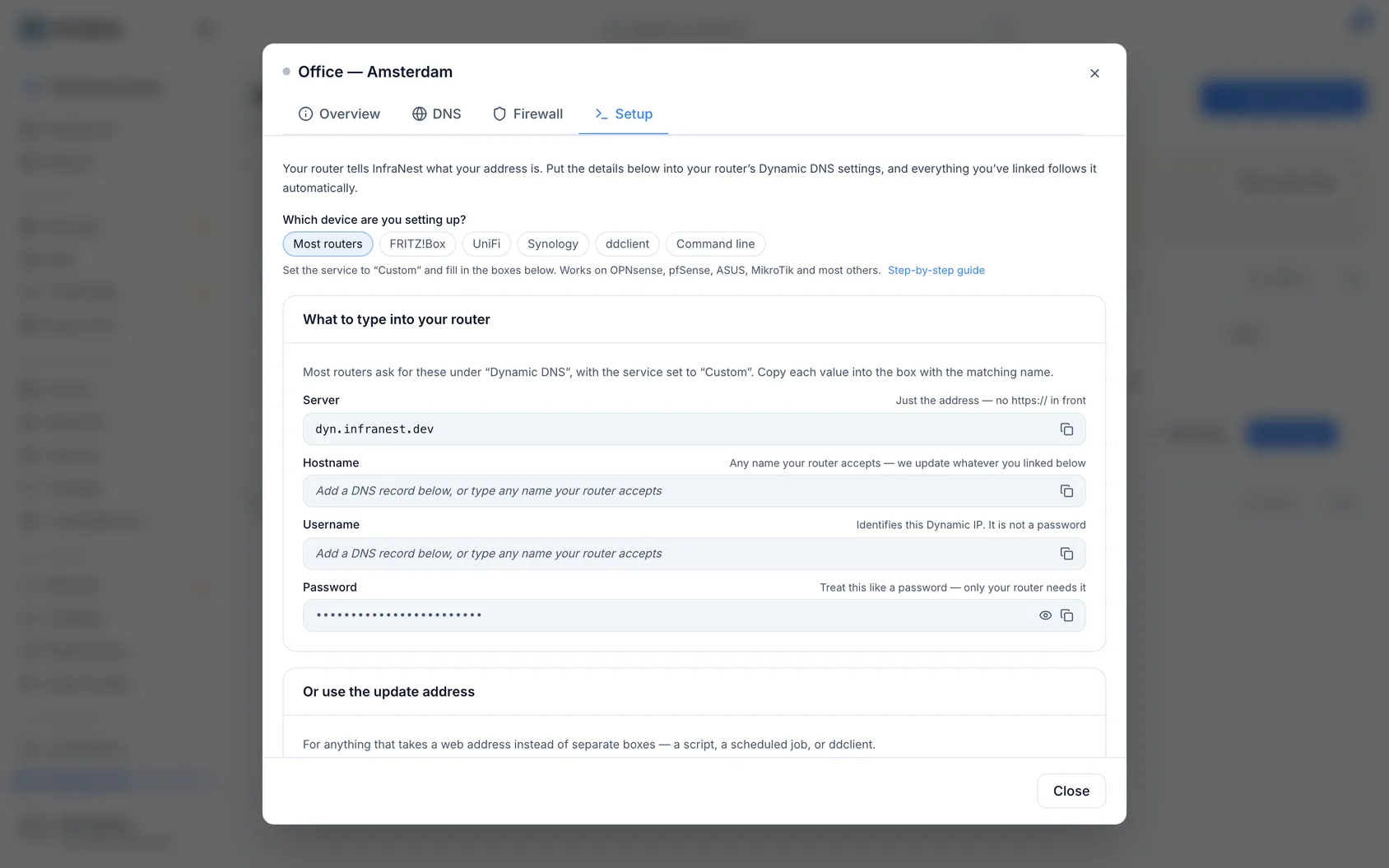
Almost every router calls these the same four things:
| Box in your router | What to enter |
|---|---|
| Service or Provider | Choose Custom (sometimes "User-defined" or "Other") |
| Server | The address shown on the Setup tab — without https:// in front |
| Hostname | Any name your router accepts. We update whatever you linked, whichever name you type |
| Username | The dyn-… value shown. It identifies this Dynamic IP and is not a password |
| Password | Select Show to reveal it, then copy it |
Some devices — FRITZ!Box and Synology among them — ask for a single web address instead of a separate Server box. The Setup tab shows that address for those, labelled the way the device labels it.
NoteLeaving
https://in the Server box is the single most common mistake. Most routers add it themselves and end up with a broken address.
Check it worked
- Save the settings in your router.
- Leave the Setup tab open. Under Has your router reached us? the page watches for about a minute and updates by itself the moment your router calls in — showing when it arrived, from which address, and whether the password was right.
If it says the password was wrong, copy it again from the Password box; that's the most common cause.
Choose what follows your address
- Go to the DNS tab and add the records that should follow your IP — pick existing A (IPv4) or AAAA (IPv6) records, or create one here.
- Go to the Firewall tab and add inbound cloud-firewall rules, so remote access keeps working when your address changes.
One Dynamic IP can keep several records and rules up to date across different providers at once. You can also start from the other end: on a DNS record or a firewall rule, choose Track with a Dynamic IP.
If the rule already allows an address
When you link a firewall rule that already allows one or more addresses, you'll be asked whether one of them is you.
Say so if it is. That entry then becomes the one we keep up to date, so you end up with one address in the rule instead of two. If you skip the question, your address is added as a new entry and the existing ones are left exactly as they are — which is fine when they belong to a colleague, an office, or a monitoring service.
TipIt's worth answering that question. An address that was yours under an old internet connection stays in the rule forever otherwise, and providers hand those addresses to other customers.
Options worth knowing
- Alert me when the IP changes — get a message (email, Slack, Telegram) with the old and new address.
- Only trust the address we actually see — ignore an address your router claims and use the one the request genuinely came from. Recommended for firewall rules.
- If your router goes quiet, close the firewall opening — after about a week of silence, remove the allow-list entry so an abandoned setup can't leave a port open. You're warned before this happens.
- Replace the password — issues a new one if the old might have leaked. Your router will need the new password.
Troubleshooting
- Password rejected — copy it again from the Password box on the Setup tab; passwords are easy to mistype or truncate when copying.
- Router won't save the Server box — check you removed
https://from the front of the address. - Update never arrives — double-check you picked the right device in the list on the Setup tab, since the exact boxes and wording vary by device.
Was this article helpful?