

Automation templates are ready-made automations you can set up in a couple of clicks — a fast way to see what automations can do, without building one from scratch yourself. This article is for anyone managing automations in InfraNest.
#Overview
- Templates come filled in with what InfraNest already knows about your workspace, so most can be saved as they are.
- InfraNest also suggests templates based on what you've connected, and based on things you already do by hand.
- Every rule, template-based or not, can be checked before it runs for real.
#Use a template
- Go to Automations.
- Open the Templates gallery.
- Pick a template to see what it does — its trigger, its conditions and the actions it will run, written in plain language.
- Select it to create a rule from it.
- Adjust anything you want, then save.
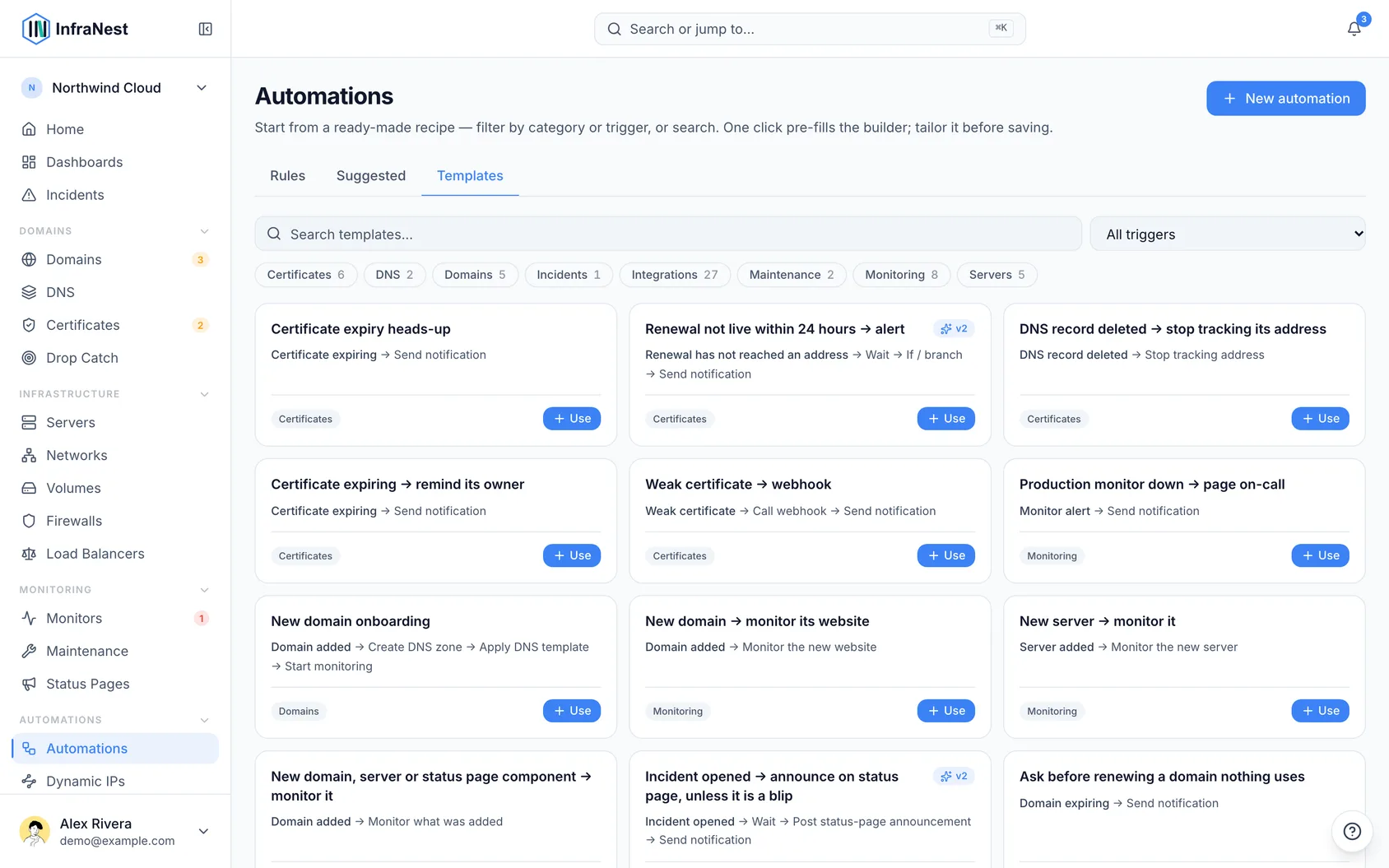
A template opens filled in with what InfraNest already knows about your workspace, so most can be saved as they are:
- A step that notifies your team goes to your alert destinations (or to you, if you have none yet).
- In an escalation chain, the people who acknowledge outages most often come first, then the next person.
- A step that posts to a status page or sends to an endpoint uses your only one. With more than one, you choose.
The summary next to the editor says when each step happens — for example, wait 5 minutes (and stop there if someone is on it or it recovered) — and who each notification goes to.
The rule is yours from that moment. Editing it later doesn't affect the template, and the template never changes your rule.
#Review a recommended template
Above your automations, InfraNest suggests a few templates that fit what you have already connected. You see the same suggestions on an integration's page, and right after you connect one.
They're chosen from what InfraNest can see in your workspace:
- What a template needs. Each template needs certain things before it can do anything, like GitHub and a status page to post your releases. A template only shows up when you have them.
- One thing short. A template that needs one more thing still shows up, with what's missing and a link to set it up — for example, Needs Cloudflare first.
- What you already run. A template you've already made an automation from isn't suggested again.
- What you said no to. Select Not for us and that template isn't suggested again to anyone in your workspace.
With PagerDuty connected, its page suggests templates such as opening a PagerDuty incident a few days before a certificate or domain expires, paging on-call when a GitHub workflow fails on main, and telling your team when an incident is resolved in PagerDuty. Monitor alerts already reach PagerDuty without an automation, so there is no template for those.
Each suggestion says what it does and why it is offered:
- When … Then … — what starts it and what it does.
- Only informs or Changes something. A suggestion that only informs tells someone: it sends a message, posts on your status page, or opens a ticket. One that changes something acts on your servers, DNS or monitors.
- A line from your own last 30 days, such as It would have posted 3 times this month and skipped 11 blips, or 2 outages this month waited more than 5 minutes for someone.
The Suggested tab on the Automations page lists every suggestion, not just the few shown above your automations.
- Select Review to open the template in the editor, filled in. Nothing is created until you save it, so you can check and change everything first.
- Or, if a suggestion only informs and is ready to run as it is, select Turn on. This creates the automation and switches it on straight away.
NoteA suggestion that changes something always opens for review first, as does one that still needs you to choose where to send it.
Some examples of what gets suggested:
- A server that restarts on a schedule. When the InfraNest agent sees a server restart at the same time on the same weekday three weeks running, this suggestion sends you a link to a weekly maintenance window for that server and hour, filled in. Nothing is created until you save it.
- A server behind a load balancer that stops answering. When a monitor on a server is down from every location it checks from for two minutes, this suggestion takes that server out of every load balancer that sends it traffic and tells your team, then puts it back once the monitor recovers. It always opens for review first.
- A volume that is filling up. When the disk forecast says a volume will be full within 7 days, this suggestion grows it by 25%, never past the maximum size you set when you review it. It needs the InfraNest agent on the server, and because it spends money, it always opens for review first.
- A monthly uptime report for a client. On the first of the month, this emails your client last month's uptime figures — the same figures as your Uptime report — for their status page's monitors or for a tag you choose. Add your client's email address when you review it.
On Home, you see at most one suggestion, and only when nothing needs your attention.
#Automate something you do by hand
When you've done the same follow-up by hand at least three times in the last 45 days, InfraNest suggests the template that would do it for you. Today it looks for:
- adding a monitor to a new server → New server → monitor it
- switching on auto-renew for a domain about to expire → Auto-renew expiring domains
- posting a status page announcement after an outage → Incident → status announcement
It suggests this on Home when nothing needs your attention. It also asks right after you do it again, at most once a week: That's 3 times you added a monitor to a new server. Let an automation do it from now on?
- Select Draft it to create the automation switched off and open it in the editor.
- Read through the rule.
- Switch it on when you're ready — nothing runs until you do.
It isn't suggested if you already have an automation that does it, or if you chose Not for us for that template.
#Check it before you trust it
Every rule — from a template or not — can be tried before it runs for real:
- Select Test run to see exactly what would happen, without doing any of it.
- Select Would have run to replay the rule against events that already happened, so you can see how often it would have fired.
TipBoth are worth a minute, especially for a rule that changes something at a provider.
#Save your own template
- Open the rule you want to reuse.
- Save it as a template.
- Find it in the Templates gallery alongside the built-in ones, ready to use again — for another workspace, or as a starting point for similar rules.
#Tips
- A template only fills in the rule. Anything it needs — a connected integration, a destination for notifications — still has to exist for the rule to work.
- Templates you save belong to your workspace; nobody outside it sees them.
- New domain → monitor its website and New server → monitor it keep your monitoring complete as you grow. They add one monitor for each new website or server and change nothing at your registrar or provider. When your plan has no room left, they add nothing rather than adding a monitor that would be paused, and the run history says so.
Was this article helpful?
Thanks for your feedback!
Thanks, this goes straight to the docs team.