

Automations let InfraNest react to things happening across your infrastructure on its own, so you don't have to watch every domain, server, or monitor yourself. This article is for anyone who wants to understand how automations work before building one.
#Overview
- You set up a rule once — when this happens, do that — and InfraNest runs it hands-free every time it applies.
- Rules can cover anything from domains and DNS to servers, monitoring, incidents, certificates, maintenance, drop-catch, dynamic IPs and status pages.
- Once saved, a rule keeps working quietly in the background until you change or turn it off.
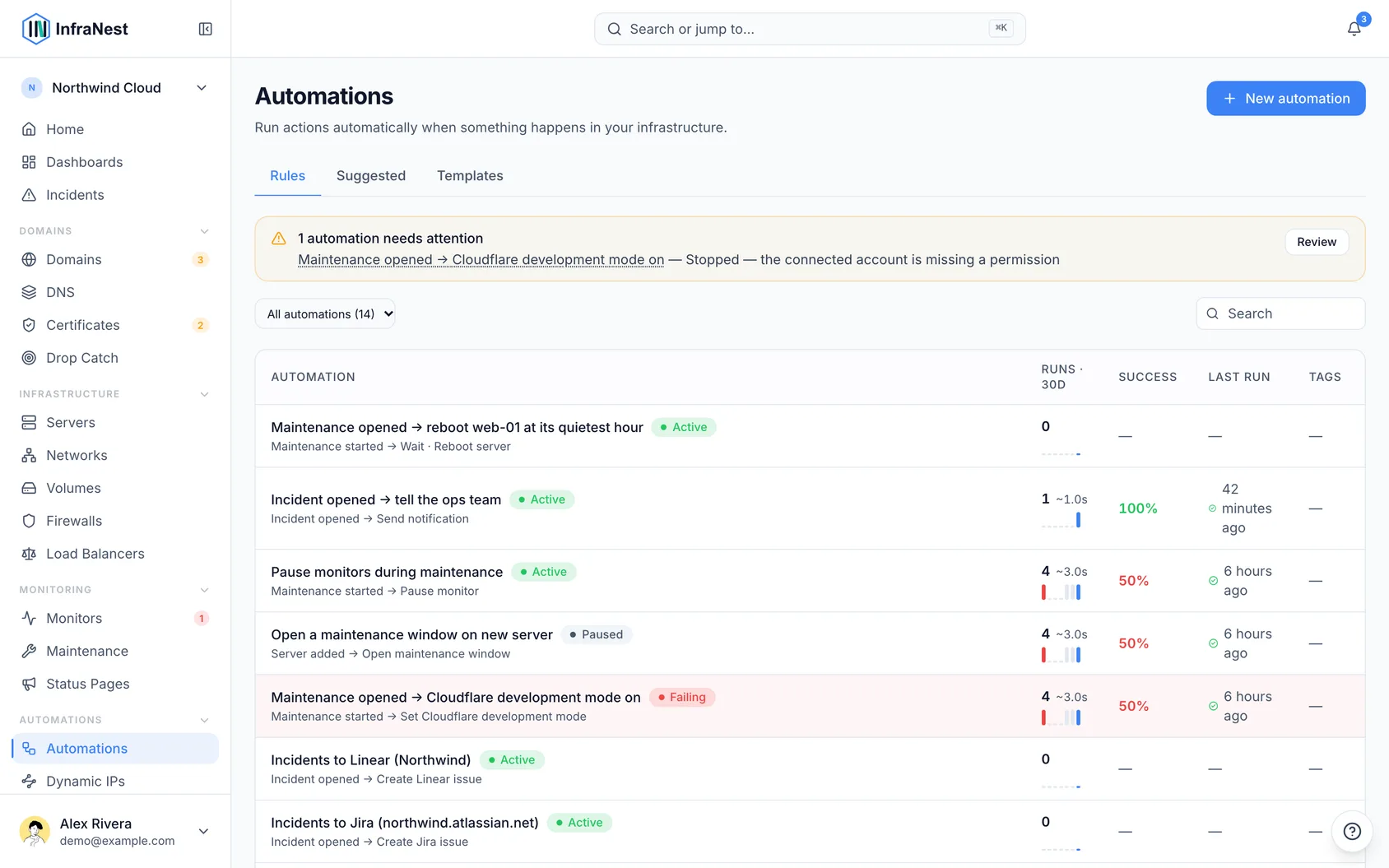
#How a rule works
- Trigger — this is the event that starts the rule. Triggers span the whole platform, covering domains, DNS, servers, monitoring and incidents, certificates, maintenance, drop-catch, dynamic IP, and status pages.
- Conditions (optional) — these are filters that must match before the rule runs, using the Add condition option. For example, you could limit a rule to only run when a domain has fewer than 7 days left, only when a monitor goes down (not up), or only for a certain tag.
- Actions — this is what the rule actually does, added with Add action. Actions range from Send notification and Call webhook to Open maintenance window, Apply DNS template, Resolve incident, or Set auto-renew.
For the complete list of what you can trigger on and do, see Automation triggers and actions. For ready-to-copy rules, see Automation examples.
#Use a template
- Open Automations from the sidebar.
- Go to the Template library tab.
- Browse the options, or choose Browse all templates to see everything available.
- Pick a template and select Use to start from it, or choose Start from scratch to build your own instead.
- Adjust the trigger, conditions, and actions to fit your needs, then select Save automation.
NoteRules act on future events only — creating a rule doesn't retroactively apply to things that already happened.
TipA single rule can run several actions at once — for example, you could Send notification and Open maintenance window from the same trigger.
#Good to know
- Automations are shared across your workspace, and how many you can create may depend on your plan.
- Every time a rule runs, it's recorded in your Audit Log, so you can see exactly what it did.
- Each run shows up under Runs, and you can check Last run for a quick status.
Was this article helpful?
Thanks for your feedback!
Thanks, this goes straight to the docs team.
Still stuck? Contact support
Related articles
Automation rulesAutomation examplesA few ready-to-copy automations to show what's possible. Build any of these under Automations → New automation, or start from the Templates tab.Automation rulesAutomation triggers and actionsThe full list of what an automation can react to (triggers), the ways to narrow when it runs (conditions), and what it can do (actions).Automation rulesLet InfraNest fix known failures for youSome failures have a fix that is always the same: take a broken server out of the load balancer, restart a server that has frozen, give a filling disk more…Automation rulesAutomation conditionsConditions decide when a rule actually runs. Without them, a rule runs on every matching event; with them, it runs only when the event's details match.