

Automations let InfraNest take action for you whenever something happens in your infrastructure, so you don't have to react manually.
Overview
- An automation reads as When → If → Then: when an event fires, if your conditions match, then it runs your actions in order.
- Use automations to save time on repetitive responses — like alerting your team, updating a ticket, or rebooting a server — whenever a specific event occurs.
- You can build a rule from scratch or start from a ready-made template.
Create a rule
- Go to Automations and select New automation.
- Under When, pick a trigger — the event that starts the rule.
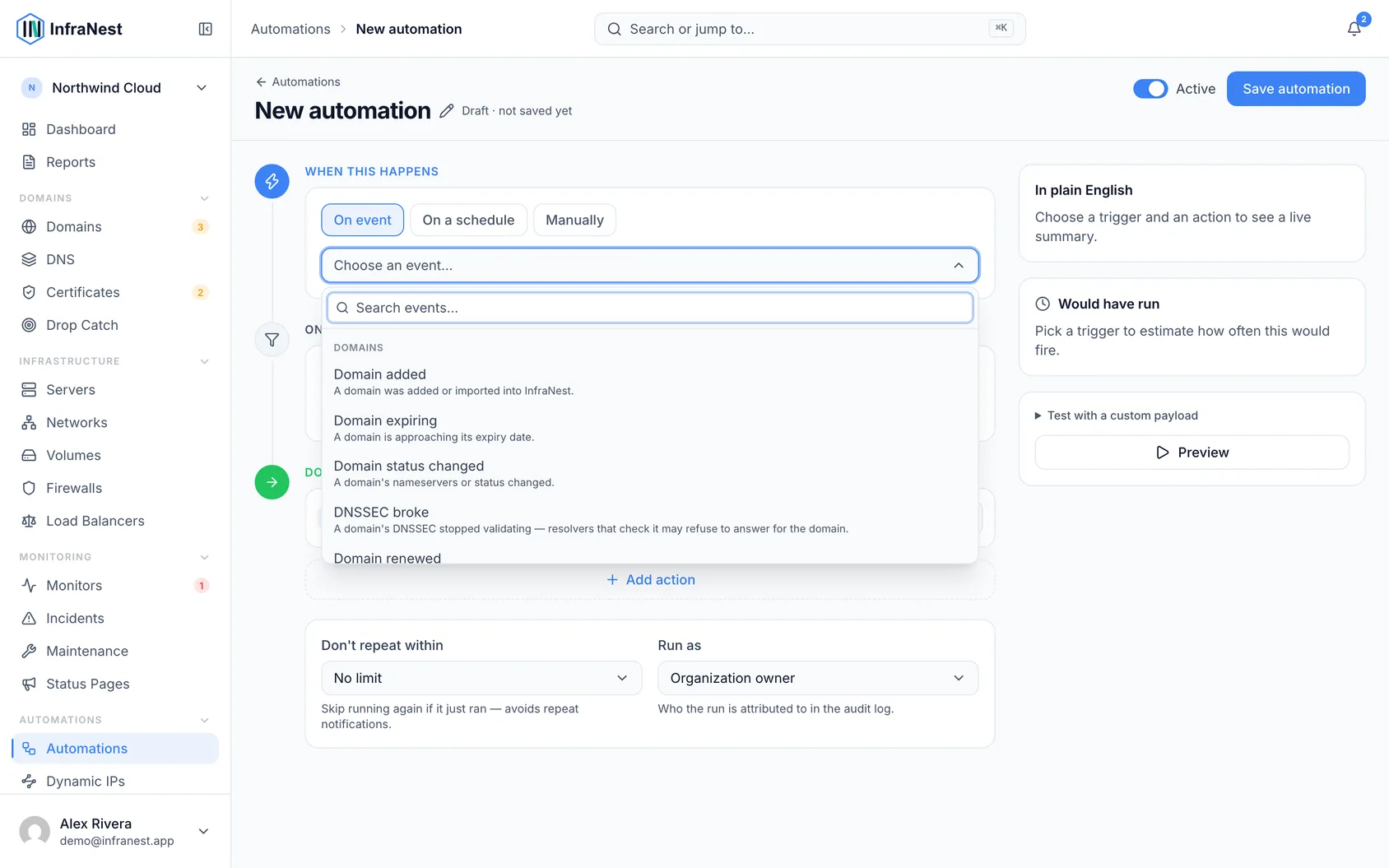
- Under If (optional), select Add condition to narrow when the rule runs. All conditions must match for the rule to continue.
- Under Then, select Add action to add one or more actions. They run in order, top to bottom.
- Select Preview (dry run) to see what the rule would do against a real example, then select Save automation.
TipUse Preview (dry run) before saving — it shows you exactly what would happen without actually running any actions.
Start from a template
- Open the Template library tab.
- Select Browse all templates to see the ready-made recipes.
- Select Use on a template to start from it.
- Adjust its trigger, conditions and actions to fit your needs, then select Save automation.
Manage a rule
- Go to Automations and find the rule you want to manage.
- Use Turn on or Turn off to pause a rule without deleting it.
- Select Edit to change the trigger, conditions or actions.
- Set a Cooldown so the rule doesn't fire again too soon for the same thing.
NoteCooldown applies per item, not per rule. A rule covering fifty domains still handles all fifty — the wait only applies to each domain individually, so one of them being handled never holds up the others.
- Select Delete to remove a rule you no longer need.
After it runs
- Open the automation and check its Runs tab to confirm it worked and see each step's result.
- Look for statuses like Last run failed or Auto-disabled after repeated failures if something went wrong.
- Runs are also listed in your Audit Log for a full history.
Troubleshooting
- If a rule stops firing, check whether it shows Switched off after repeated failures — you may need to fix the underlying issue and turn it back on.
- If actions aren't running as expected, review your Conditions — remember all conditions must match, shown as {n} of {total} matched in the run details.
Was this article helpful?
Related articles
About automationsAutomations let InfraNest react to things happening across your infrastructure on its own.Automation conditionsConditions decide when a rule actually runs. Without them, a rule runs on every matching event; with them, it runs only when the event's details match.Placeholders and formattingPlaceholders let an automation drop live details from the event into a message, title or webhook — so instead of a generic "A certificate is expiring" you…Start from an automation templateTemplates are ready-made automations you can adopt in a couple of clicks — the fastest way to see what automations can do without designing one from scratch.