

Alert defaults let you set monitoring rules once for your whole organisation, instead of repeating the same setup on every server. This article is for anyone who wants consistent alerts without configuring each server by hand.
Overview
- An alert default is a rule that automatically applies to every server you have monitoring switched on for.
- Any single server can be given its own numbers without changing the rule for everyone else.
- This saves you from setting up the same "disk almost full" style rule over and over again.
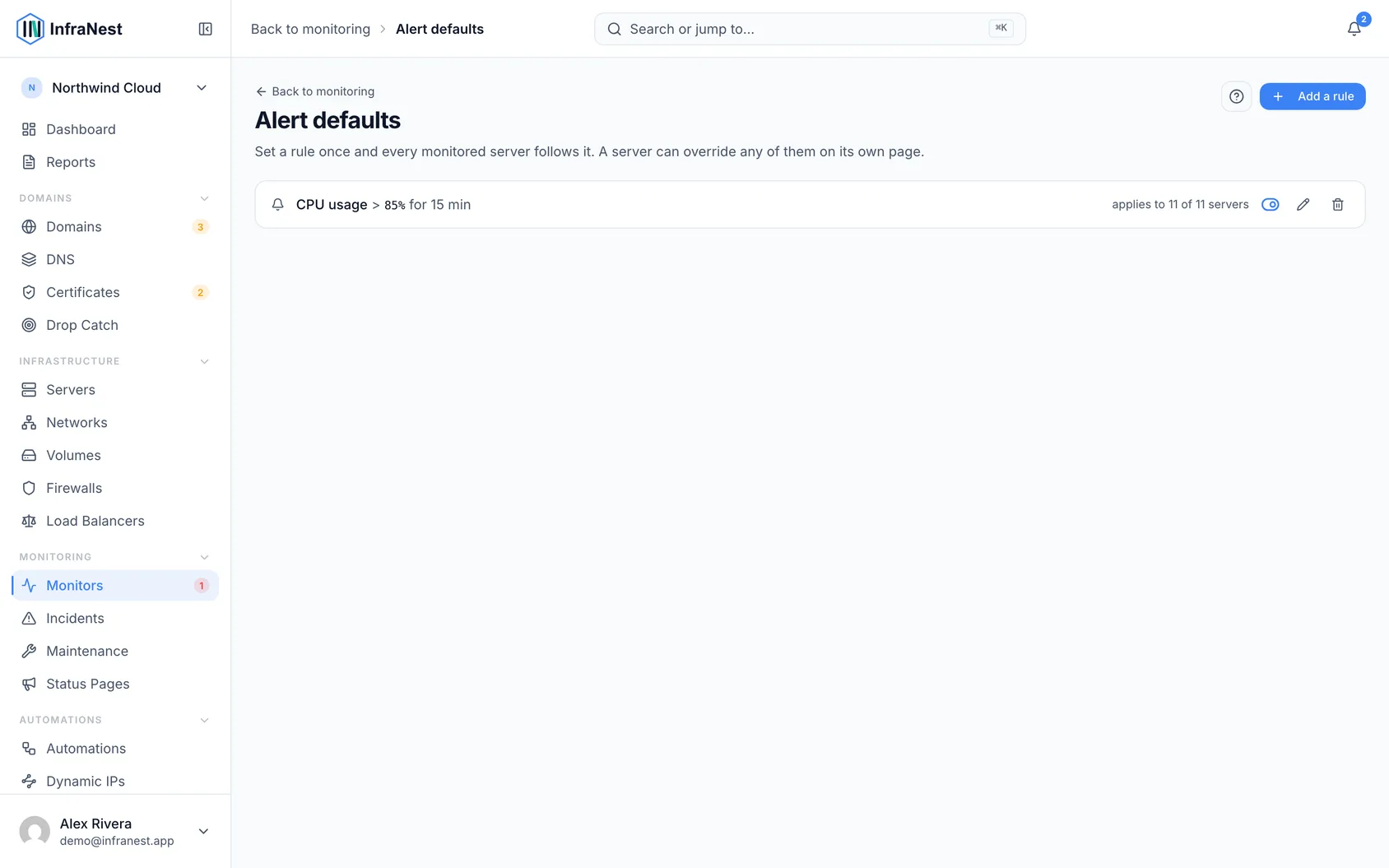
Set them up
- Go to Monitoring and choose Alert defaults.
- If you haven't set any yet, you can start with the usual four — CPU, memory, disk space, and a warning when a server stops reporting. Once added, they're ordinary rules, so you can change or remove any of them.
- Otherwise, choose Add a rule and pick what to watch, the threshold, and how long the reading has to stay over the line before it counts.
TipThat duration setting matters more than it looks. A very short duration turns every brief spike into an alert, and alerts nobody can act on are the ones people start ignoring. Ten minutes is a sensible starting point for most things.
What each rule is actually watching
Every rule shows how many servers it applies to — for example, "applies to 12 of 14 servers" — and how many of those have been given their own version instead.
Rules marked Needs agent watch something no cloud provider reports: memory, disk space and load only exist on the machine itself. Those rules are real, but they only ever fire on servers where the agent is installed. On the others, they sit quietly and never trigger — worth knowing before you rely on one.
Change one server
- Open the server from Monitoring → Servers.
- Go to its Alerts & rules tab. Rules that come from your organisation's defaults are marked Org default.
- Change the numbers on a rule and it becomes Overridden here — only that server is affected.
- Choose Reset to put it back on the organisation's rule.
- You can also add a rule that exists only on that one server, and nowhere else.
WarningSwitching a default off switches it off everywhere, including on servers that had customised it.
Delete a default
- Go to Monitoring and choose Alert defaults.
- Find the rule you want to remove and choose Delete.
Deleting a rule stops it applying to every server that inherits it, and those servers stop being alerted on it.
Servers that had customised that rule lose their version too. That's deliberate: a customised copy of a rule nobody watches any more isn't a rule, and leaving it behind would bring the alert back the moment a new default for the same thing was created.
Was this article helpful?