

Incidents are InfraNest's automatic record of an outage — created the moment a check confirms something is really down, and closed automatically once it recovers. This article is for anyone who needs to track, acknowledge, or review outages for their infrastructure.
Overview
- A confirmed failure opens an incident that captures the impact, the likely cause, and how long it lasts.
- Incidents from planned maintenance are marked as planned, so they don't count against your unexpected downtime.
- Every incident has a timeline you can post updates to, and it resolves itself when the underlying check recovers.
How incidents work
- When a check fails for real (not a one-off blip), InfraNest opens an incident automatically.
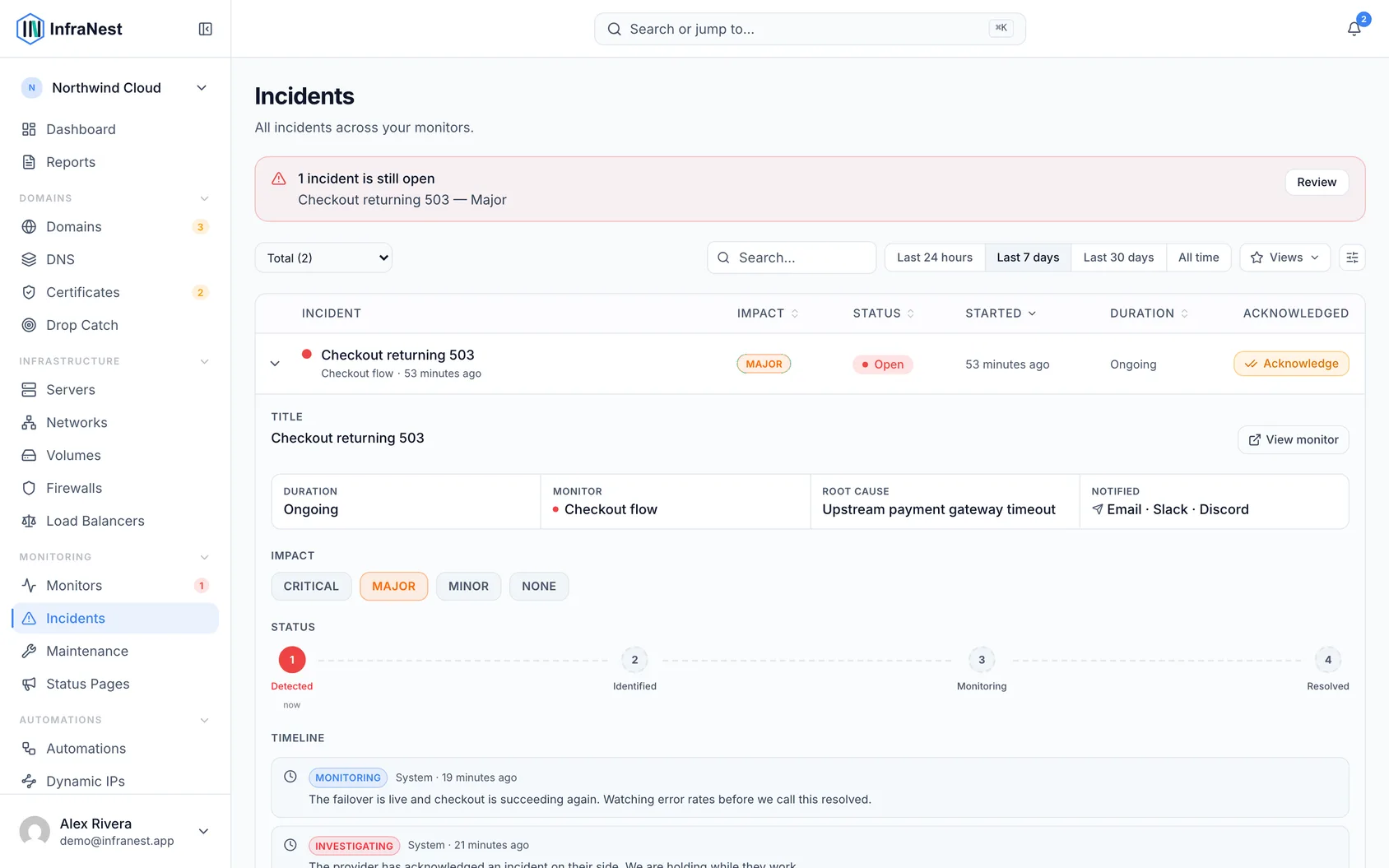
- The incident records the impact and cause, and starts timing how long it lasts.
- You can acknowledge the incident so your team knows someone's already on it.
- Post updates to the incident's timeline as you learn more or as things change.
- Once the check recovers, the incident resolves on its own — no action needed from you.
NoteIncidents tied to planned maintenance are labeled as planned, so they're excluded from your unexpected downtime.
Avoid alert storms with dependencies
- Identify a check that, if it goes down, would naturally cause other checks to fail too (for example, a shared network or load balancer).
- Open that upstream check's settings and set the affected checks to depend on it.
- When the parent check goes down, alerts for its dependent checks are suppressed automatically.
- You get one incident for the real, root-cause outage — not a flood of separate alerts for every affected check.
Understand the alert emails you'll receive
- When something goes down, you receive an email letting you know.
- When it comes back up, you receive a second email — this one tells you how long the outage lasted and how fast the service is responding now.
- The "back up" email is sent even to destinations set to critical alerts only, and even outside their quiet hours, since if a destination heard about the outage, it also hears when it's resolved.
- Each email includes a View incident link that opens that exact incident, with its full timeline and comment box, no matter how old it is.
TipUse the comment box on an incident's timeline to leave notes for your team — it's a handy record of what was checked and when.
Review incidents on the Incidents page
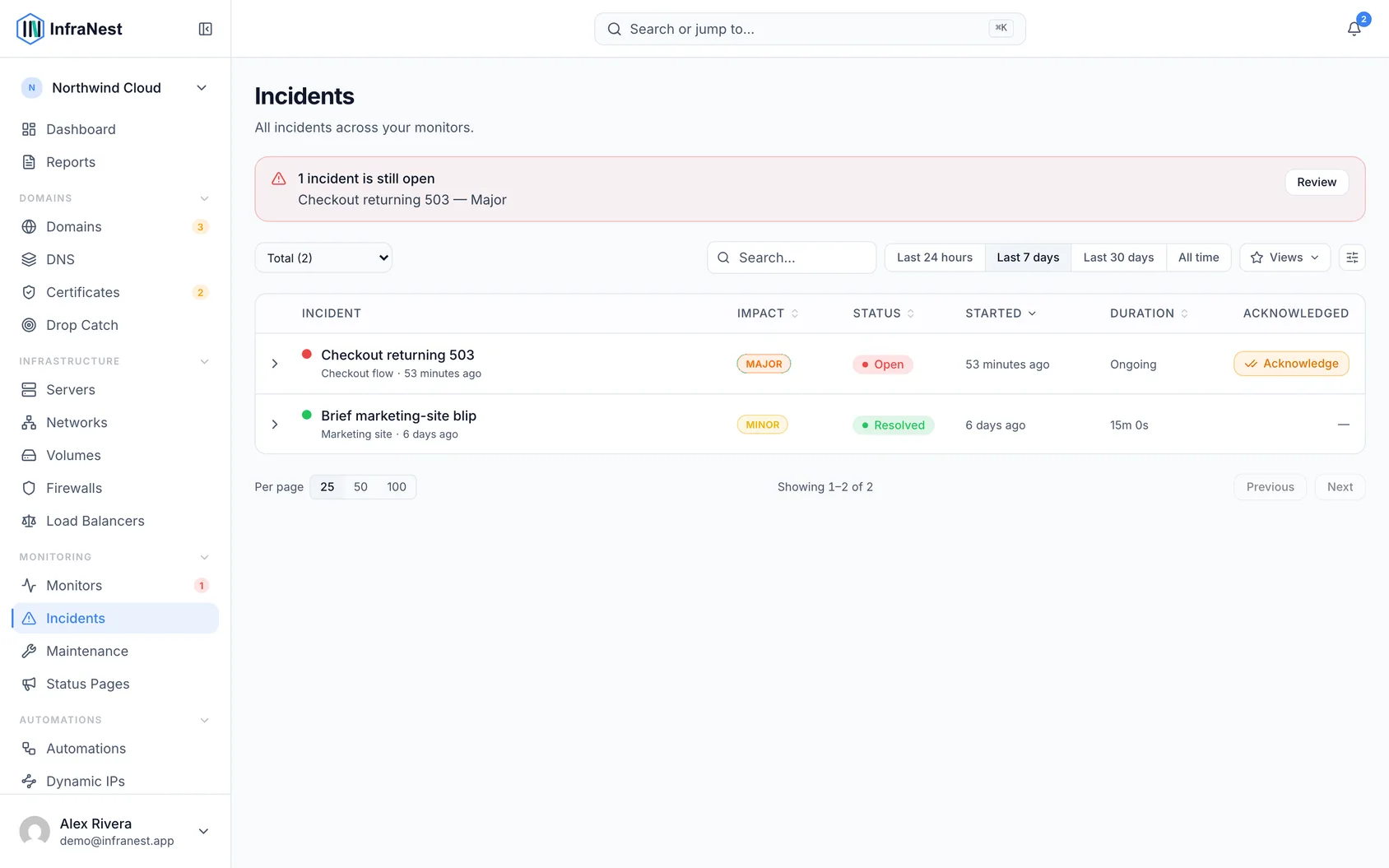
- Go to Incidents in the sidebar to see the full list.
- Use the filter to narrow the list to open, acknowledged, or resolved incidents.
- Select any incident to open its full timeline.
- If you arrived via an alert email's View incident link, you'll see just that one incident with a notice at the top — select Show all incidents to return to the complete list.
Troubleshooting
- Getting too many alerts for one outage? Set up dependencies between checks so only the root-cause check triggers an incident.
- Can't find an old incident from an email link? Select Show all incidents from the notice at the top to browse the complete list on the Incidents page.
Was this article helpful?