

Keep an eye on a backup script, cron job or scheduled task by having it check in with InfraNest — this is for anyone who wants to know the moment a routine job silently stops running.
Overview
- A heartbeat monitor works in reverse to most checks: instead of InfraNest reaching out to your service, your job calls in to InfraNest each time it finishes.
- If the call-in doesn't arrive on time, InfraNest raises an alert.
- This is the best way to catch a job that has quietly stopped running, rather than one that's just slow to respond.
Set one up
- Go to Monitors and select add a monitor.
- Choose Heartbeat / Cron monitor as the type.
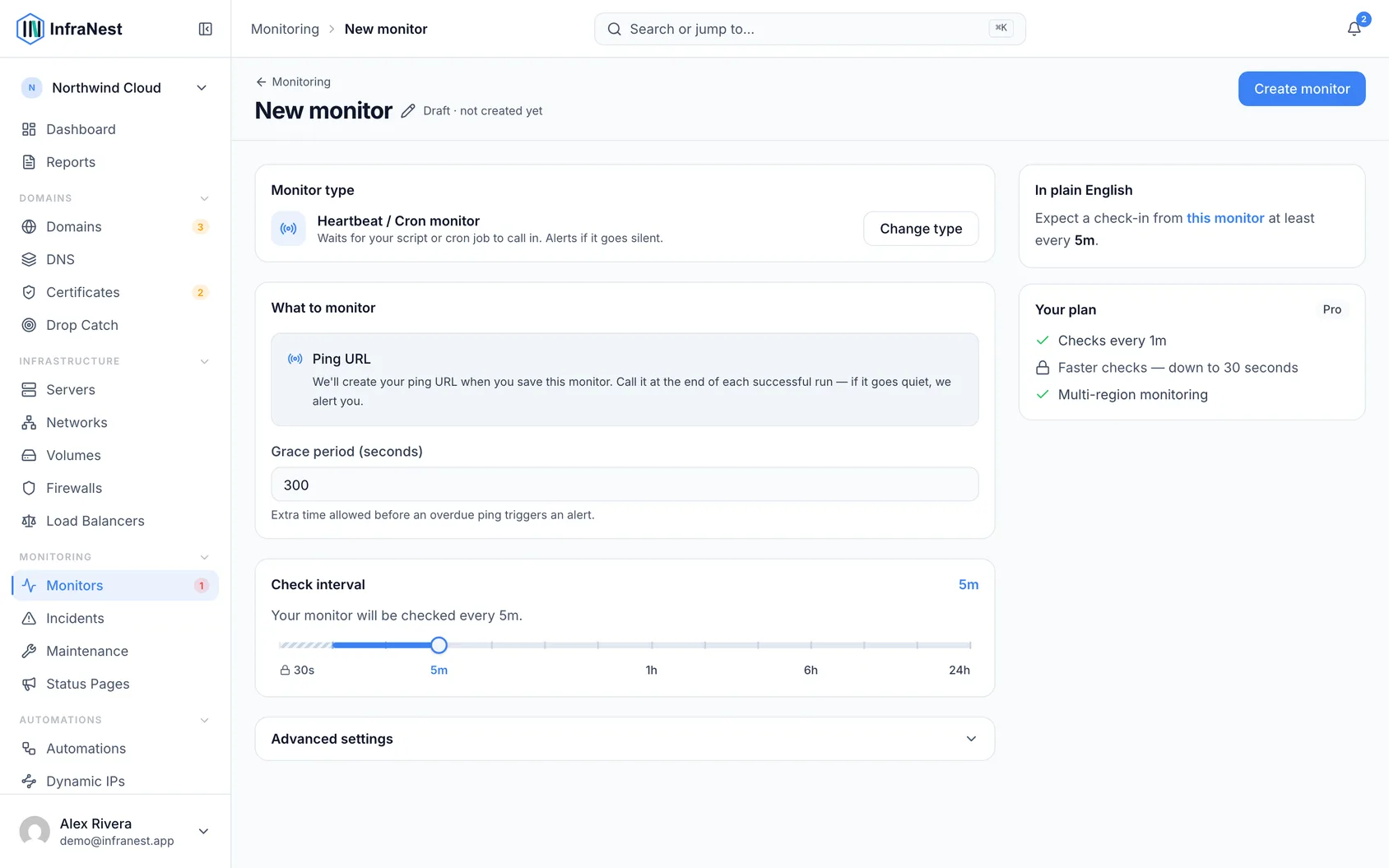
- Give it a name you'll recognise in an alert — "Nightly database backup" beats "job 1".
- Set the check interval to how often the job is supposed to run.
- Set a grace period — extra time allowed before the job is called late. A backup that usually takes four minutes but occasionally takes eight needs a grace period comfortably longer than that overrun.
- Select create monitor.
You don't enter a URL for this type — InfraNest creates one for you when you save.
Make your job check in
- Open the monitor to see its ping URL, plus a ready-to-paste one-liner.
- Add that line to the end of your script or cron job, so it only runs when the job actually succeeded:
0 3 * * * /usr/local/bin/backup.sh && curl -fsS -m 10 --retry 3 https://your-infranest-url/api/heartbeat/your-uuid
- Keep the
&&in place — it means the check-in only happens if the backup itself exited successfully. A failed job then stays silent, and silence is what raises the alert. - Use the Copy button rather than retyping the URL — the identifier in it is unique to this monitor.
What happens next
- Every check-in marks the monitor Active and records the time as its last ping.
- A brand-new monitor stays pending until its first window has passed, so you have time to wire the check-in up without being alerted about it.
- If nothing arrives within the interval plus the grace period, the monitor goes Inactive and opens an incident, so your usual alert destinations fire.
- The next check-in resolves the incident and alerts you that it's back — you don't have to close it by hand.
NotePausing a heartbeat monitor is safe: the ping URL keeps answering normally, so a job that's still calling it won't start reporting failures. InfraNest simply stops watching until you resume.
TipTreat the ping URL as a secret. Anyone who has it can report your job as healthy — which would hide a real failure.
Troubleshooting
- No ping received yet on the monitor means InfraNest hasn't heard from the job at all. Run the curl line by hand from the same machine: if that turns the monitor Active, the problem is in your script, not here.
- If the machine can't reach the internet outbound, the check-in can't arrive — allow outbound HTTPS to InfraNest.
- A monitor that alerts every night at the same time usually has a grace period shorter than the job's real worst-case runtime.
Was this article helpful?
Related articles
Add a monitorSet up a check to watch a website, API, certificate, DNS record or anything else, and get told when something's wrong.About monitoringMonitoring watches your websites, APIs, servers, DNS and certificates from several regions, confirms real outages before it alerts you, tracks incidents, and…Monitor typesInfraNest can watch ten different kinds of target. Pick the one that matches what you want to check.Monthly uptime reportGet uptime per monitor for a single calendar month — the figure you can send a client, because it stops changing once the month is over.