

Monitors are how InfraNest keeps an eye on your servers, sites, and services — this article explains the different kinds of checks you can run and how to make sense of SSL warnings.
Overview
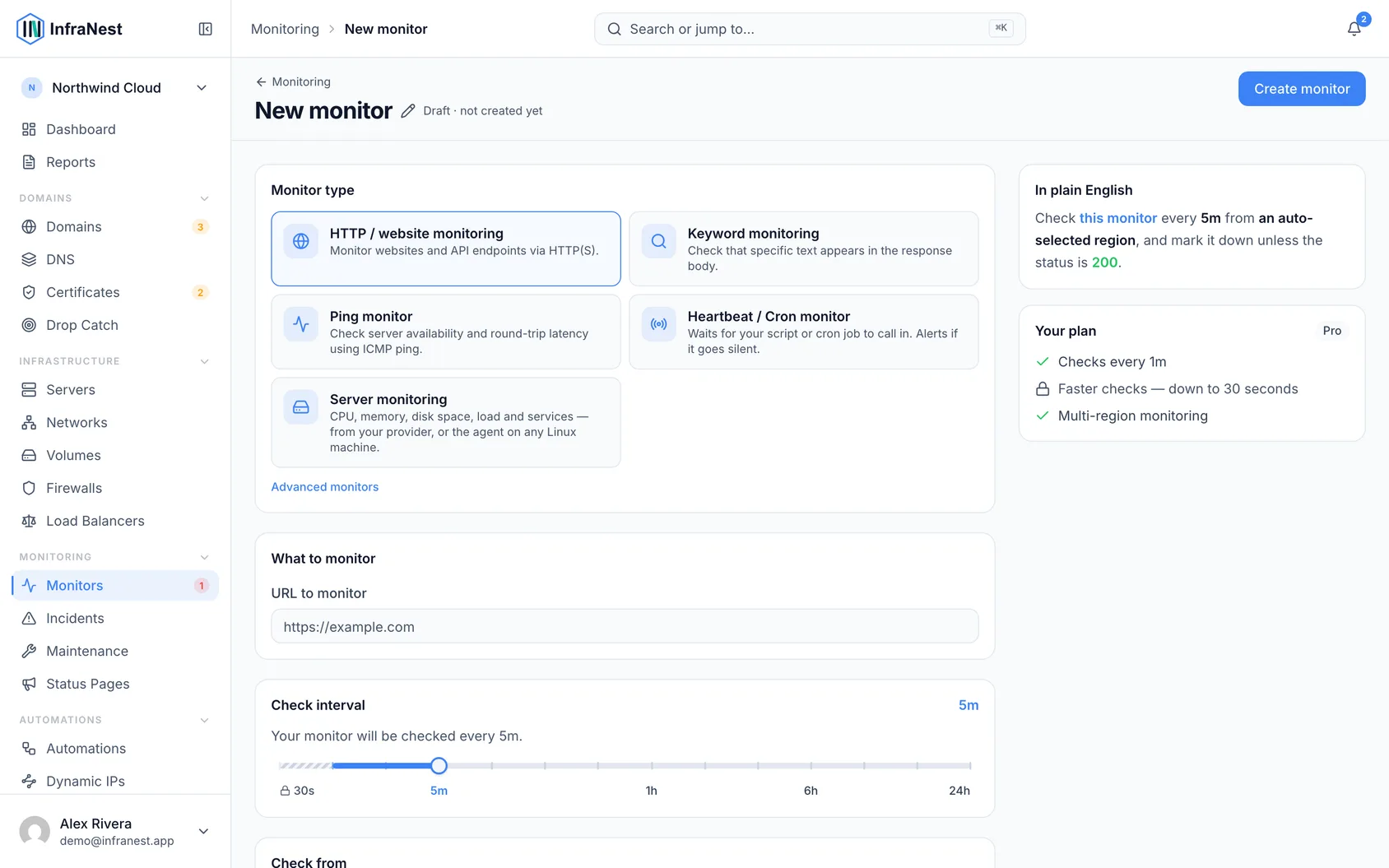
- InfraNest supports ten monitor types, each suited to a different kind of check.
- Pick the type that matches what you actually want to watch, rather than defaulting to one type for everything.
- Some types do more than just check status — for example, an SSL monitor also adds the certificate to your certificate list.
Choose the right monitor type
- HTTP — confirms a website or URL is reachable and healthy, and can detect slow responses.
- API — checks that a JSON or multi-step API endpoint behaves as expected.
- Port (TCP) — checks that a TCP port is open and accepting connections.
- SSL — checks that a certificate is valid and not near expiry, and adds it to your certificate list.
- DNS — checks that a DNS record resolves, optionally matching an expected value.
- Keyword — checks that a page contains (or doesn't contain) some expected text.
- Redirect — checks that a URL redirects to the address you expect.
- Ping (ICMP) — checks that a host answers a ping.
- Heartbeat — a "dead man's switch" for cron jobs; your job must check in each interval or you're alerted.
- Third-party — mirrors another company's public status page, so their outages show up on yours.
TipFor an HTTP check you can also turn on an SSL sub-check to watch the certificate's expiry, without creating a separate SSL monitor.
Understand SSL monitor warnings
- Open your SSL monitor and find the Warn when expiring within (days) setting — this is how many days before expiry you want to be warned, with 30 as a sensible default.
- Know that a certificate expiring soon does not turn the monitor red. The certificate still works, so the monitor stays up and no incident opens — you're just notified by email or your chosen destination, with details on the monitor's detail page. Only an actually expired certificate counts as an outage. This matters if the monitor is a component on a public status page, since an upcoming renewal isn't something your customers need to see as a problem.
- Note that self-renewing certificates are judged differently. Most certificates today (for example, from Let's Encrypt or similar services) are issued for 90 days and renew automatically with 30 days remaining — so a healthy certificate would otherwise trigger a warning on every renewal.
- For these, InfraNest watches the renewal instead of the expiry date, and alerts you only if the renewal should have happened and didn't — leaving you around 25 days to fix it.
- Check whether a certificate is treated this way on the monitor's detail page, under Renewal.
- If it's set up incorrectly, correct it on the certificate itself in your certificate list.
Tips
NoteOnly an expired certificate is treated as an outage — an expiry warning is informational and won't affect your public status page.
Was this article helpful?
Related articles
Add a monitorSet up a check to watch a website, API, certificate, DNS record or anything else, and get told when something's wrong.About monitoringMonitoring watches your websites, APIs, servers, DNS and certificates from several regions, confirms real outages before it alerts you, tracks incidents, and…Monitor a cron job or scriptMost checks reach out to something of yours. A heartbeat monitor works the other way around: your backup script, cron job or scheduled task calls in to…Monthly uptime reportGet uptime per monitor for a single calendar month — the figure you can send a client, because it stops changing once the month is over.