

Import a zone file to bring your DNS records into InfraNest, whether you're setting up a new zone or already have one here. It's aimed at anyone moving DNS from another provider.
Overview
- A zone file is the standard export almost every DNS provider can produce, and importing one is the fastest, most complete way to bring records across.
- It's more thorough than a DNS scan, which can only find records it can guess the names of — a zone with lots of subdomains would come across incomplete with a scan. A zone file contains everything.
- Nothing is written until you confirm the import, so it's safe to preview and try again.
Import a zone file into an existing zone
- First, export a zone file from your current DNS provider. Look for Export zone file, Export BIND file, or Download records.
- Open DNS and click the zone you're importing into.
- Click Actions → Import zone file and choose the file.
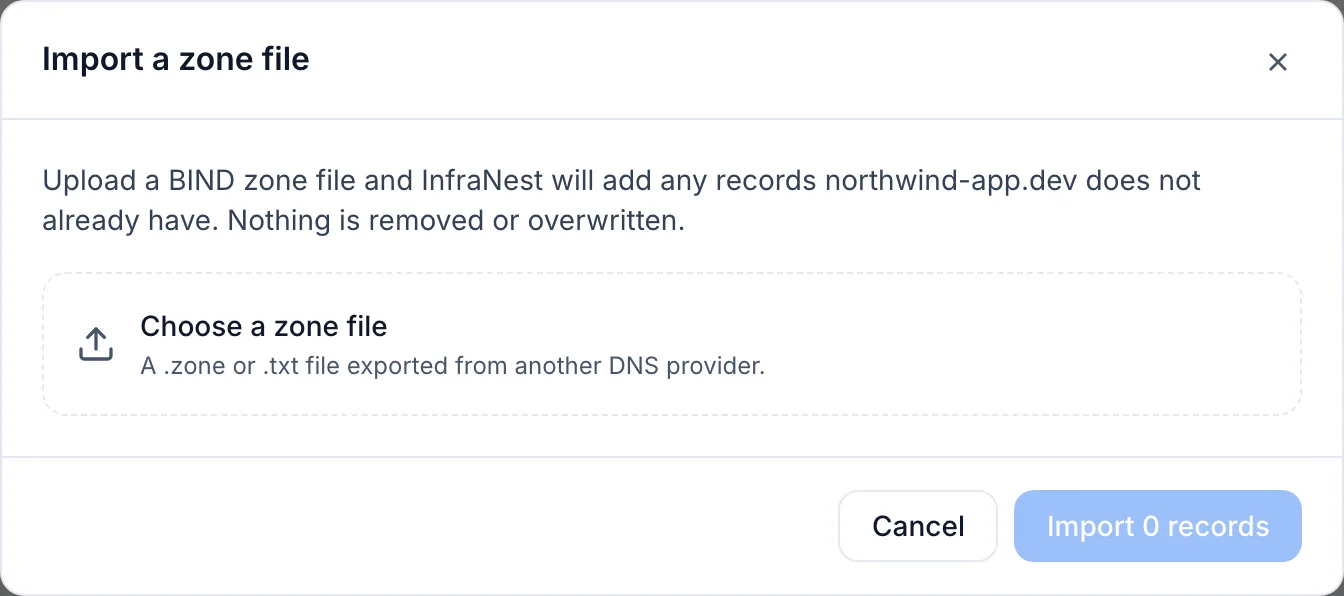
- Read the summary, then click Import.
Import a zone file while adding a new zone
- Open DNS → Add zone and enter the domain name.
- At How do you want to set up DNS, choose Upload a DNS zone file and pick your file.
- The wizard tells you how many records it found and how many lines it will skip.
- Finish the wizard — the zone is created and the records are imported in one go.
NoteIf the file turns out to be for a different domain than the one you typed, the wizard says so and stops. That's deliberate — importing it anyway would put every record under the wrong name.
What the preview tells you before anything happens
The preview shows:
- To add — records in the file that your zone doesn't have yet. These are what gets imported.
- Already present — records that match something in the zone exactly. Left alone.
- This provider will not accept — record types your DNS provider doesn't support. Better to know now than to have an import stop halfway.
- Skipped — lines that can't become records, each listed with its line number and the reason.
Common reasons a line is skipped, none of which mean anything is wrong:
- SOA and nameserver records at the top of the zone. Your DNS provider owns these and creates them itself.
- Records for a different domain. If the file contains names outside this zone, they're refused rather than silently renamed.
- Record types InfraNest doesn't support. Rare, and always named so you can add them by hand.
Importing only adds
An import never deletes and never overwrites. If a record already exists it's left exactly as it is, and if you import the same file twice the second import adds nothing.
That also means it's safe to try: import, look at your records, and import again after fixing the file if something was missing.
One consequence worth knowing: if a record exists in both places with a different value — say your MX points somewhere new — you'll end up with both. That's deliberate, because a domain legitimately has several MX records and guessing which one to delete could break your mail. Check your MX and TXT records after importing and delete anything you no longer want.
Move from another provider, start to finish
- Export the zone file at your old provider.
- Create the zone in InfraNest (DNS → Add zone) if it doesn't exist yet.
- Import the zone file and check the records look right.
- Only then point your domain's nameservers at the new provider.
TipDo the nameserver change last. Until you change it, the old provider is still answering, so there's no outage while you get the records right.
Troubleshooting
- "Could not read that zone file" — the file may not be a BIND zone file. CSV or a provider's own export format won't work; look for a "BIND" option when exporting.
- Records are read-only — the zone belongs to a provider InfraNest can't write to. Add the records in the provider's own control panel, then use Sync this zone.
- Some records didn't arrive — the message tells you how many and why. Your provider may have rejected them, or rate-limited a large import. Import the same file again; anything that already landed is skipped.
Was this article helpful?