

This article explains how InfraNest handles DNS for your domains, and who should read it if they manage domains, email, or website security settings.
Overview
- InfraNest manages the DNS for all your domains in one place, no matter which provider hosts them.
- Import your zones, edit records in a single consistent editor, and InfraNest pushes the changes to the provider for you.
- It also keeps an eye on drift, security gaps, and what the internet actually sees for your records.
What you can do
- One editor for every provider. Zones from Cloudflare, Amazon Route 53, Hetzner, TransIP, GoDaddy, IONOS and Namecheap all live together in InfraNest, edited the same way.
- Two-way sync. Records you change in InfraNest are pushed to the provider; records changed at the provider are pulled back into InfraNest. If something changed outside InfraNest without going through the sync, it's flagged so you can see it.
- Keep DNS and email secure. A built-in security check looks at each zone for SPF, DMARC, DKIM, MX, DNSSEC and CAA, and tells you what's missing.
- Roll out standard records with Templates. Save a working set of records and apply it to any zone.
- We check what the internet actually answers. From time to time, InfraNest asks public DNS servers what they return for your records and compares that with what's stored in InfraNest. If they differ, you get an email naming each record — its name, its type, what InfraNest holds, and what the resolvers are answering right now — with a link straight to the zone. Nothing is changed automatically; the email just tells you what visitors and mail servers are currently being told.
- Manage whole zones. Discover, create and delete zones, copy records between zones, or import by scanning live DNS.
Find the DNS page
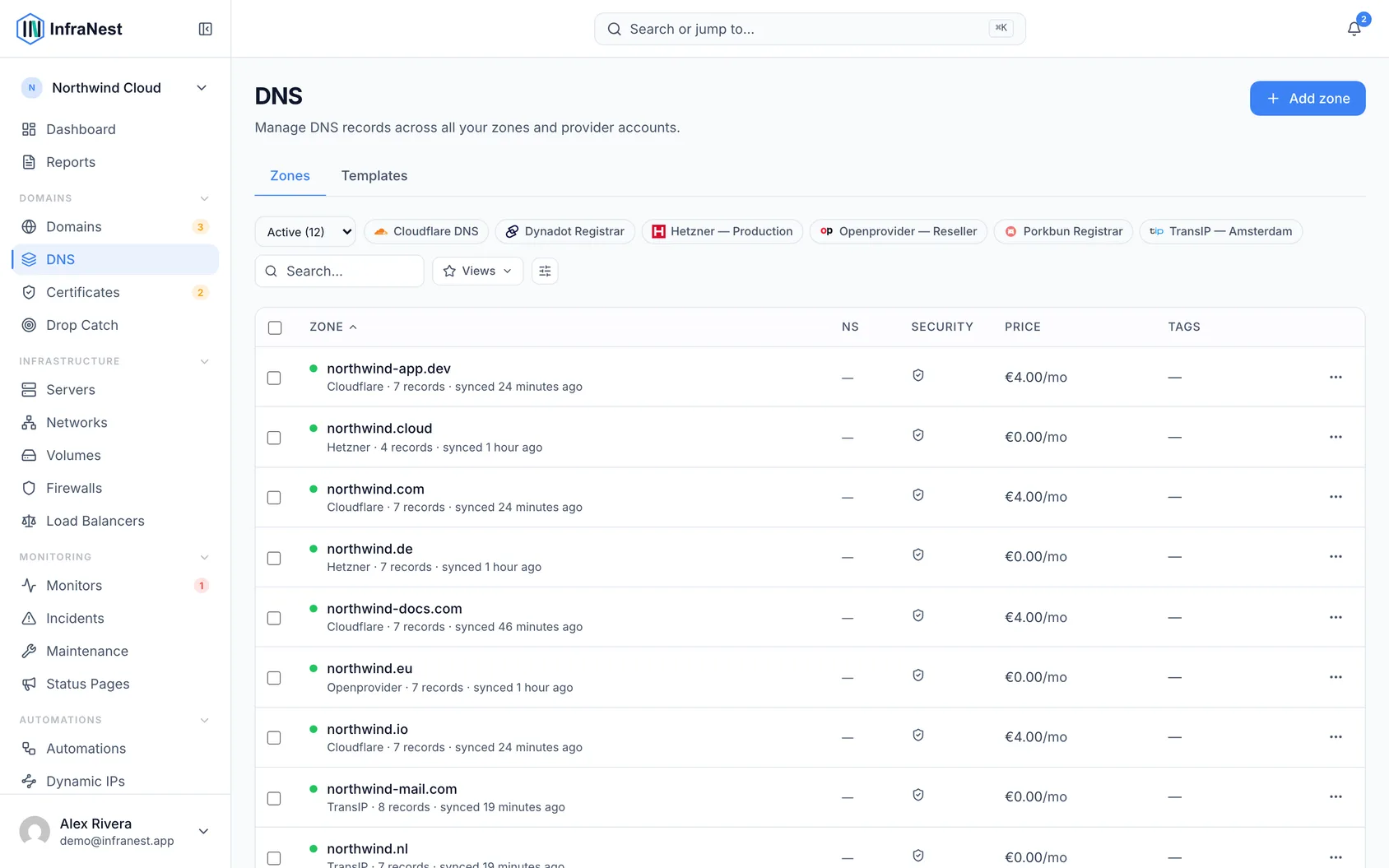
- Open the sidebar and select DNS.
- You'll see a list of all your zones across every provider, showing Status, Provider, record count, and when each zone was last synced.
- Use Search or Filter to narrow the list, or Add tag… to organize zones with Tags.
- Select Discover zones to find zones already set up at a connected provider, or select Create to start a new zone.
- Select any zone in the list to open it and manage its records.
Understand two-way sync and drift
- When you change a record in InfraNest and select Save changes, InfraNest pushes that change to the provider.
- When someone changes a record directly at the provider, InfraNest pulls that change back in during the next sync.
- If a record was changed outside InfraNest in a way that hasn't synced yet, it shows up as out of sync or Not yet synced to provider so you know to review it.
- Use Sync this zone to refresh a zone on demand rather than waiting for the next automatic check.
Check what the internet actually sees
- InfraNest periodically checks public DNS servers to see what they return for your records.
- If the live answers differ from what's stored in InfraNest, you'll receive an email listing each affected record, its type, the stored value, and the live value.
- Open the link in the email to go straight to the zone in InfraNest.
- From the zone, use Check propagation or Verify live to see the current picture, and Show stored to compare against what InfraNest has saved.
- Nothing changes automatically — decide whether to Send mine to the provider or Overwrite with live values based on what you find.
NoteThese checks only report differences by email — they don't change any records for you. You choose what to do next from the zone page.
TipSave a set of records you use often as a template under DNS Templates, then use Apply template to roll it out to any zone in seconds.
Was this article helpful?
Related articles
Add a DNS zoneCreate a DNS zone with a short wizard that does the cross-provider work for you — including pointing your domain at the new provider.Cloudflare settings the advisor checksSome of the most important security settings for a website are not DNS records at all.Check DNS and email securityEach zone has a Security Advisor that checks the DNS records that matter for email delivery and security — reading your domain's live DNS, so it's accurate…Download a zone fileYou can download any DNS zone as a zone file — a plain text file in the standard BIND format that almost every DNS provider, registrar and hosting control…