

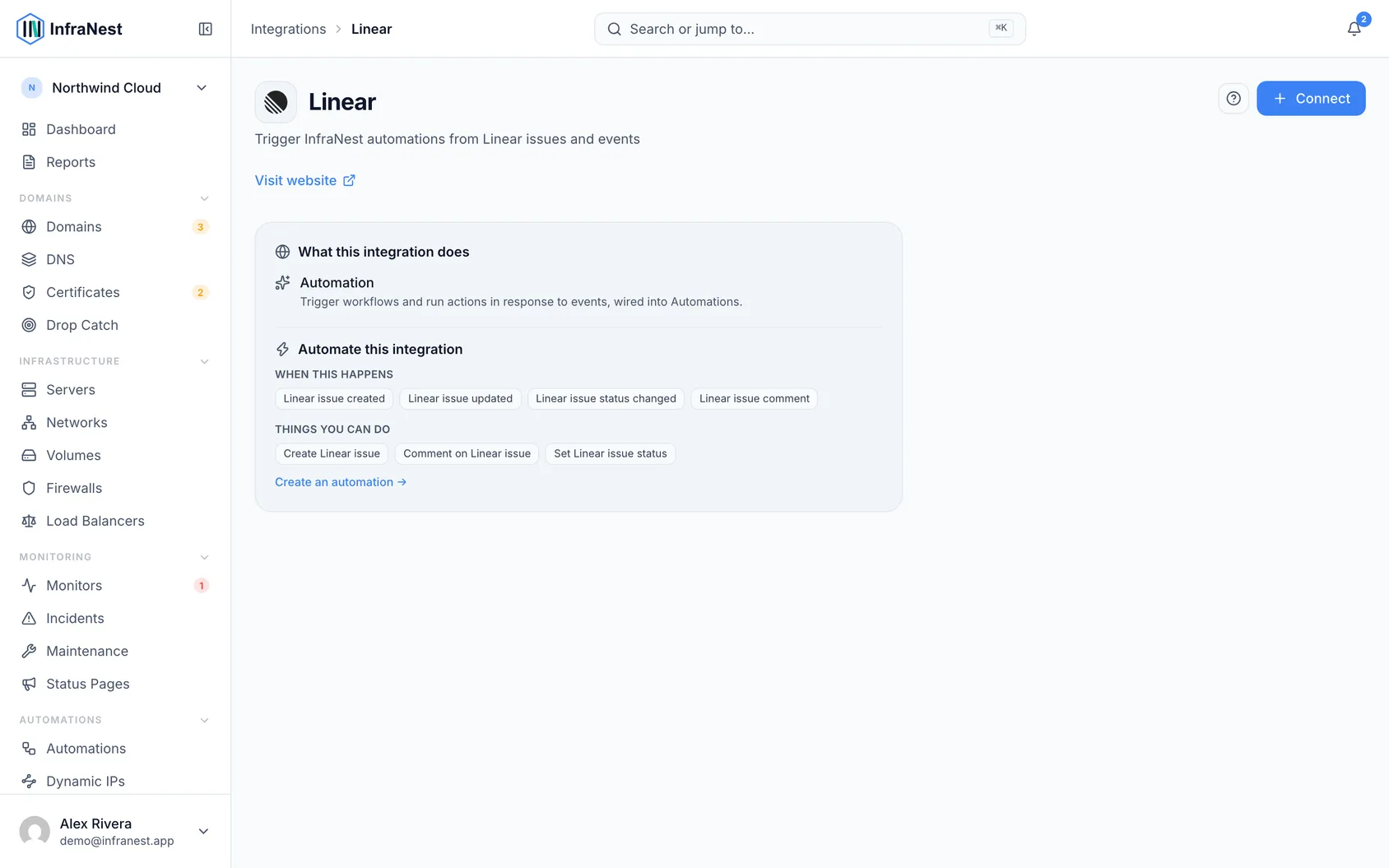
Connect Linear so your automations can open, comment on, or update issues automatically — a certificate about to expire, a monitor that went down, a domain coming up for renewal — filed on the right team without anyone copying details across by hand.
Overview
- Linear connects either with one click (OAuth) or with an API key.
- Once connected, your automations can create issues, comment on them, and change their status.
- Issues land on the right team, with the details from whatever triggered the automation already filled in.
Connect your workspace
- Go to Settings, then Integrations.
- Find Linear and click it.
- Approve the workspace when Linear asks.
- You'll land back in InfraNest already connected — nothing to copy.
NoteIf the connect button is greyed out, your InfraNest administrator hasn't registered a Linear app yet. Use an API key instead — it works the same way once connected.
Connect with an API key
- In Linear, open Settings → Account → Security & Access.
- Under Personal API keys, create a key. Give it Read and Write access.
- Copy the key — Linear only shows it once.
- In InfraNest, go to Settings → Integrations → Linear, paste the key, and click Save.
InfraNest checks the key right away and shows the workspace it belongs to, so you can confirm you connected the right one.
WarningA key can be limited to specific teams. If you restrict it, make sure it includes the team you want issues in — a key that excludes it will connect fine and then fail when an automation runs.
The key is tied to the person who created it. If they leave, the key stops working — for a connection the whole team relies on, an admin's key or the one-click connect option is the safer choice.
Create issues from an automation
- Build a rule as usual.
- Pick Create Linear issue as the action.
- Set Team — start typing and pick from your Linear teams, or type a team key like
ENG. - Fill in Title and Description — plain text, and you can drop in values from whatever triggered the rule, so the issue arrives with the domain name or monitor already in it.
- (Optional) Set Status — leave it empty and Linear puts the issue wherever that team's new issues normally go.
- (Optional) Set Project and Assignee — projects are listed for the team you picked; anyone in your workspace can be the assignee, or type their email address instead of picking.
- (Optional) Set Priority, using Linear's own scale (1 is Urgent, 4 is Low).
The issue the rule creates is available to later steps in the same rule, so you can post its link to Slack straight after creating it — or comment on it, or close it, using the actions below.
Comment on an issue, or change its status
- Add Comment on Linear issue or Set Linear issue status as a step in your rule.
- Tell it which issue — give the identifier you see in Linear (like
ENG-14), or refer to the issue an earlier step in the same rule created (the picker of earlier values offers it). - For a comment, write the text — useful as the other half of a rule that opens issues: the monitor recovers, and the issue says so.
- For a status change, type the name exactly as it appears on that team's board ("In Progress", "Done"). Statuses belong to a team, and the team comes from the issue itself, so there is no list to pick from here.
Troubleshooting
"Linear rejected the key" — the key is wrong, expired, or was created without Write access. Create a new one and paste it again.
The team list is empty. Pick a connection first, at the top of the action. If it is still empty, the key is probably limited to teams it cannot see — check its team restrictions in Linear.
The status list is empty. Statuses belong to a team, so choose the team first. If the team comes from the trigger rather than being picked, the list stays empty — you can type the status name instead and the automation resolves it when it runs.
The project list is empty. Projects belong to teams — choose the team first, and only that team's projects are offered.
An automation failed with "Linear rejected the request". Open the run in Automations → History; the step shows what Linear said. The usual cause is a team the key cannot reach, or a status name that does not exist on that team.
"No Linear user matches…" — two people can share a display name, so the automation matches on email address first. Use the address to be certain which one it means.
Was this article helpful?