

Every certificate InfraNest knows about comes from somewhere — a monitor, a connected provider, a scan, or your own upload. This article explains where those come from and how to tell them apart. It's for anyone reviewing the Certificates inventory.
Overview
- InfraNest gathers certificates from several places automatically, plus lets you add them yourself.
- Everything lands in one deduplicated list, and each certificate keeps a record of where it was found (shown as found by {source}).
- This means you can spot certificates you didn't even know existed — useful for catching unexpected issuance.
How certificates are found automatically
- SSL monitors — any SSL/TLS uptime monitor sends in the certificate it sees on every check.
- Connected providers — connect AWS (ACM), Cloudflare, Hetzner, IONOS, TransIP, Namecheap, Porkbun or SSL.com under Integrations, turn on the Certificates feature for that connection, and their certificates sync in the background.
- Certificate Transparency logs — InfraNest checks public logs daily for new certificates issued for your domains, so you'll see even ones you never added yourself.
Add certificates yourself
- Use Scan an endpoint or paste in a certificate directly — see the Add a certificate article for the full walkthrough.
- For internal servers, an agent can send many certificates at once in a single bulk import.
Import from a provider
- Go to Integrations, connect the provider you want (follow its Connect guide), and turn on the Certificates feature.
- Certificates import automatically and refresh on a schedule. If you don't want to wait, use Sync now on the connection to pull immediately.
Download the certificate files
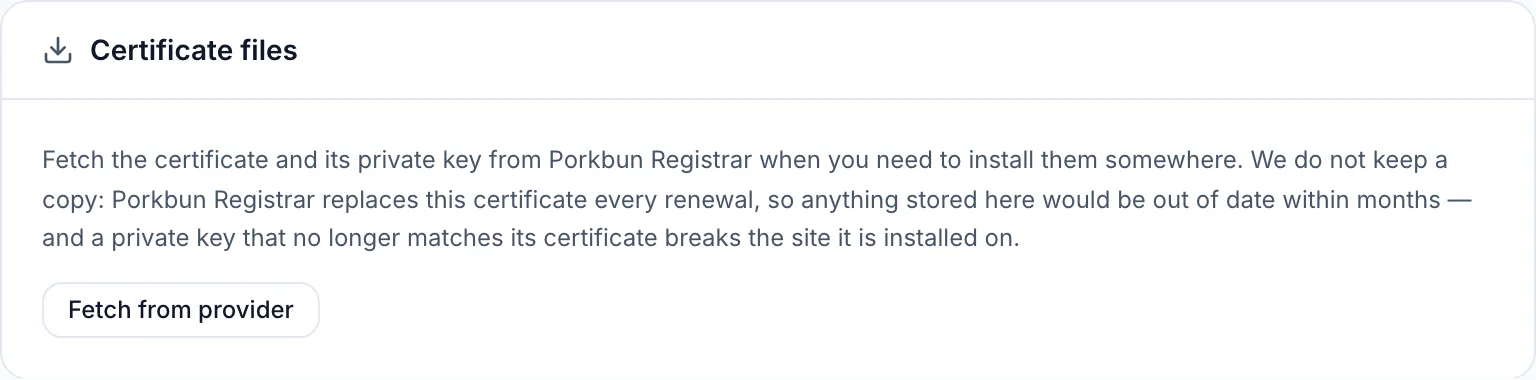
Some providers can also hand over the actual files — the certificate and its private key — so you can install them on a server yourself.
- Open the certificate's page.
- Find the Certificate files panel.
- Press Fetch from provider.
NoteInfraNest does not store a copy of your private key. Each time you press Fetch from provider, we request it fresh from the provider, show it to you, and keep nothing afterward — reload the page and you'll need to fetch it again. This is intentional: these certificates are typically replaced every couple of months, so a stored key would quickly go stale, and installing a mismatched key can take a site offline.
WarningYou need permission to make changes in the organization to fetch certificate files. Read-only members can see that a certificate exists but cannot retrieve its private key.
Tips
- Every fetch of a private key is recorded in your Audit Log, so you can always check who downloaded a key and when.
- Porkbun's free certificates are a good example of provider-fetchable files — look for the Certificate files panel on their certificate pages.
Was this article helpful?